My article on Richard Wagner and the historical background to his composing of Tristan und Isolde has just appeared in the November issue of History Today, now available in shops like Borders and W.H. Smiths. You can read the introduction of "Richard and Mathilde" online.
The magazine has also published this video of Leonard Bernstein conducting Tristran und Isolde to coincide with my article.
Showing posts with label Wagner. Show all posts
Showing posts with label Wagner. Show all posts
Sunday, October 23, 2011


Saturday, May 14, 2011
Anselm Kiefer's Parsifal in Zurich
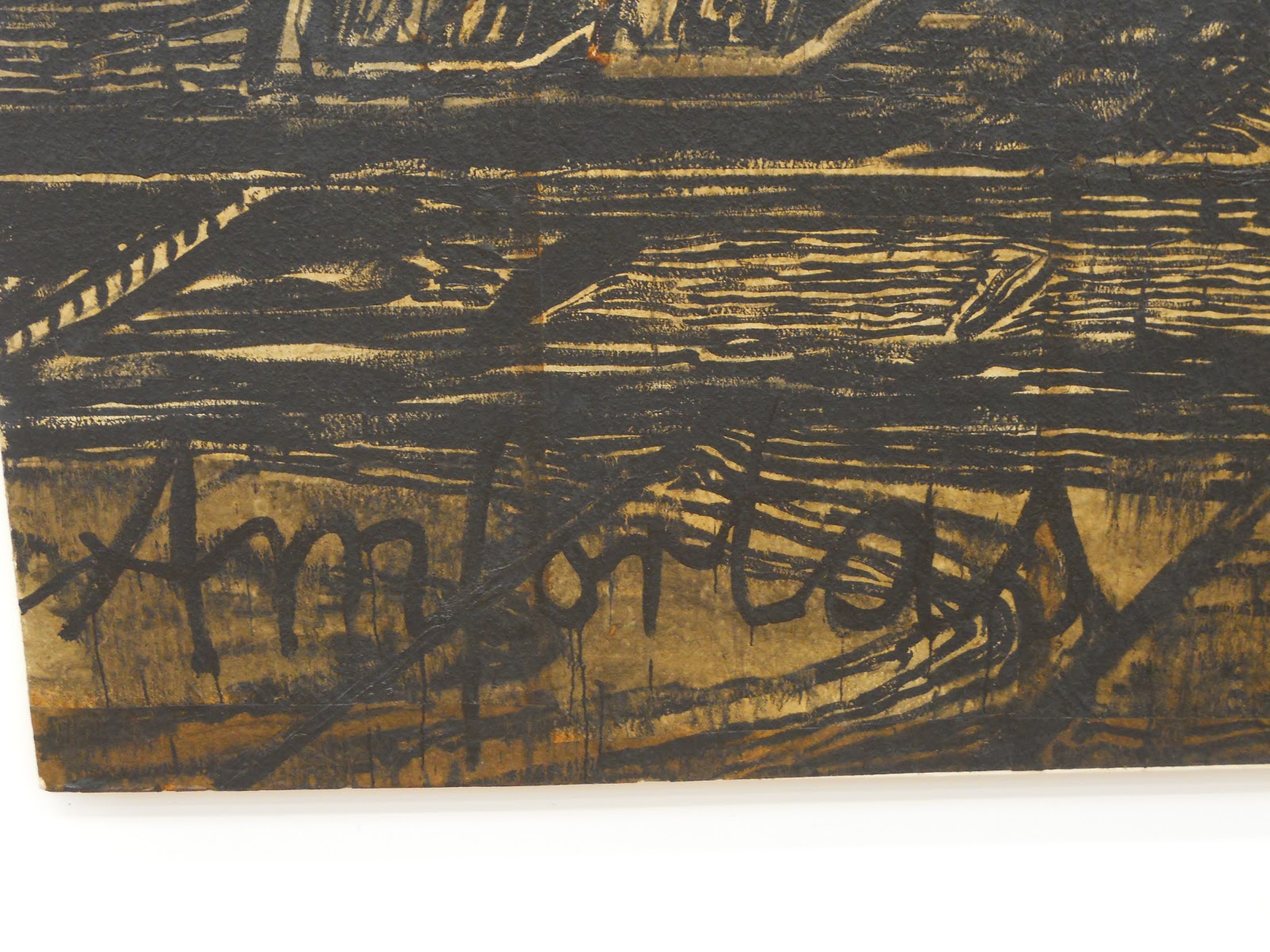
To my delight, my nine year old suggested last Saturday that we should visit the Kunsthaus together. Saturday morning turns out to be an ideal time to visit; it was like we had the museum to ourselves. Here is a photo of my daughter standing next to a great painting: Parsifal by Anselm Kiefer, painted on paper using oils and blood. You can see that it is a very large, monumental work. It is from a series of four, the other three being in the Tate Modern in London. Though photographs of the other three are widely available, this one, the largest, is more rare.

Those of you who read my blog regularly (I think that's a total of one or two) will know that I am a fan of Richard Wagner. So I was happy when I discovered some years ago this painting, that brings together one of my favourite composers with one of my favourite artists. Parsifal is, of course, Wagner's last opera, the idea of which, by coinicidence, he concieved on Good Friday in Zurich in 1857.
Anselm Kiefer's Parsifal, is not a light, joyful painting; none of his work is. Indeed I suppose you could accuse Kiefer, like Wagner, of being a bit on the heavy side. Kiefer was born in the Year Zero of German history, that is, 1945, just a month before the suicide of Adolf Hitler. As Kiefer once said, his life is the story of Germany. The painting is of his atelier, marked by ominous shadows in the foreground, and the immense wooden rafters and planks leave one in no doubt that this is a space constructed of wood. The painting has got great texture, tempting one to reach out and touch it. If I did, I imagine I would feel the splinters from the wood. For me, the space represents the primeval wood or mythical forest from which German legend and history arose. All of Kiefer's work is about this - what it means to be German, the roots out of which Germanhood arose, and the pivot around which all of German history revolves - the Holocaust. All German kultur - the stories collected by the Grimm brothers, the philosophy of Hegel, the operas of Wagner - lead to the twelve years of insanity, when Germans gave away their freedom and the greatest crime in Europe's bloody history was committed, and scarred the continent's past, present and future.
At the top of the painting Kiefer has painted the name Parsifal, while in the bottom left hand corner he has painted the name Amfortas,scrawled like the signatures of forgotten prisoners locked in some nightmarish attic space.

 According to medieval German legend Parsifal, the innocent, wonderful fool, sets out to find the Holy Grail. Amfortas, the sinner, is suffering from a spear wound that bleeds continuously. For Kiefer, the genocide of Jews and Gypsies remains the open wound that still festers and poisons our view of German history. In the centre of the painting we find the Parsifal's Holy Grail. Kiefer has painted the closing words of Wagner's Parsifal: "Höchsten Heiles Wunder! Erlosung dem Erloser!" or "Highest Miracle of Salvation! Redemption of the Redeemer" above the Grail. But Kiefer's Grail mock's Wagner's words, as it sits on a wooden stool, dripping blood, real blood. The unredemptive blood spilt by German history.

Like any great artist, Anselm Kiefer is an alchemist. He breaks down the boundaries between myth and history, the past and the future, literature, music and politics, and turns them into something more precious than gold: art that goes to the core of the human condition.

Those of you who read my blog regularly (I think that's a total of one or two) will know that I am a fan of Richard Wagner. So I was happy when I discovered some years ago this painting, that brings together one of my favourite composers with one of my favourite artists. Parsifal is, of course, Wagner's last opera, the idea of which, by coinicidence, he concieved on Good Friday in Zurich in 1857.
Anselm Kiefer's Parsifal, is not a light, joyful painting; none of his work is. Indeed I suppose you could accuse Kiefer, like Wagner, of being a bit on the heavy side. Kiefer was born in the Year Zero of German history, that is, 1945, just a month before the suicide of Adolf Hitler. As Kiefer once said, his life is the story of Germany. The painting is of his atelier, marked by ominous shadows in the foreground, and the immense wooden rafters and planks leave one in no doubt that this is a space constructed of wood. The painting has got great texture, tempting one to reach out and touch it. If I did, I imagine I would feel the splinters from the wood. For me, the space represents the primeval wood or mythical forest from which German legend and history arose. All of Kiefer's work is about this - what it means to be German, the roots out of which Germanhood arose, and the pivot around which all of German history revolves - the Holocaust. All German kultur - the stories collected by the Grimm brothers, the philosophy of Hegel, the operas of Wagner - lead to the twelve years of insanity, when Germans gave away their freedom and the greatest crime in Europe's bloody history was committed, and scarred the continent's past, present and future.
At the top of the painting Kiefer has painted the name Parsifal, while in the bottom left hand corner he has painted the name Amfortas,scrawled like the signatures of forgotten prisoners locked in some nightmarish attic space.


Like any great artist, Anselm Kiefer is an alchemist. He breaks down the boundaries between myth and history, the past and the future, literature, music and politics, and turns them into something more precious than gold: art that goes to the core of the human condition.
Monday, March 21, 2011
Wagner in Zurich
Dawn was breaking on the morning of her 29th birthday, December 23rd 1857, when the beautiful and artistically gifted Mathilde Wesendonck, wife of the multi-millionaire Otto Wesendonck, awoke in her bedroom in the splendid palatial mansion that they had had built on a green hill overlooking Lake Zurich. The sweet and melancholic sound of a chamber orchestra came from downstairs. Leaving her bedroom she crossed the gallery, with its collection of Old Masters lining the walls and descended the marble grand staircase, to the vestibule below. There, watched by marble busts of Socrates, Demothenes, Sappho and Augustus and a bronze Hermes, a small group of musicians played exquisite music, composed in her honour for the occasion. And there, conducting the ensemble, was the composer and organizer of the event, her lover and musical genius, Richard Wagner. The intense relationship that had blossomed between Richard Wagner and Mathilde Wesendonck is not simply of anecdotal interest; their love formed an integral part of Wagner’s Tristan und Isolde, acknowledged by many to be the greatest opera ever written.
 |
| Villa Wesendonck during the time of Wagner |
Wagner’s wife, Minna, was at the early morning birthday celebration too. Wagner had persuaded her to provide the sandwiches and coffee. But when Mathilde’s husband Otto, who happened to be Wagner’s generous financial patron, returned from a trip abroad he was furious when he heard how, in his absence, Wagner had orchestrated such a scene with his wife and given himself the freedom of the house. Wagner had overstepped the boundary of what was acceptable with this public gesture of intimacy, and the tongues of Zurich’s staid burghers were set to wagging.
 |
| Villa Wesendonck today: The Rietberg Museum |
Wagner and Otto mended their fences, more or less, and life returned to what constituted normal in Wagner’s world. He and Minna inhabited a house provided by Otto, next door to the Villa Wesendonck, where Otto and Mathilde lived. Here, he enjoyed the peace and quiet to compose Tristan und Isolde.
 |
| Villa Schoenberg, where Wagner composed Tristan und Isolde |
Letters and short notes rifled back and forth between Wagner and Mathilde. A few months later, in April 1858, this idyllic situation was shattered when his long- suffering wife intercepted one of his letters to Mathilde. Appalled by its intimacy she claimed (probably wrongly) that it bore witness to an illicit love affair and a scandal ensued. By August the situation had become intolerable. Wagner begged Mathilde to flee with him, but she chose her rich husband rather than her poor composer. Wagner, now estranged from his wife, fled alone to Venice, where he continued to compose Tristan in a palace on the Grand Canal, and continued to correspond with Mathilde. The following year he returned to Switzerland where he finished Tristan in Lucerne in August, 1859.
Sunday, October 24, 2010
Bernard Haitink's Tristan and Isolde at the Zürich Opera House
 |
| Zürich Opera House Last Sunday Evening |
I was amazed by Claus Guth’s staging. Act One, for instance, is supposed to take place aboard a ship on which Tristan (Stig Anderson) is bringing Isolde (Barbera Schneider-Hofstetter) from Ireland to Cornwall, where she will marry King Marke (at least that’s the plan – love gets in the way, naturally). But instead of a ship, the opera opens in what is clearly a large bedroom in a great neo-classical villa. At one point the action moves to a terrace filled with plants, definitely not a ship. It was only during the second act, when the neo-classical interior architecture continued, that the penny dropped. Actually, I can’t take the credit – it was Esther who leaned over and whispered into my ear, “It’s supposed to be the Villa Wesendonck”. Of course – why didn’t I think of that? So the staging represented, not so much the love story between Tristan and Isolde, but that of Wagner himself and his muse, Mathilde Wesendonck. The location had been moved from a ship to the place where Wagner had written the opera, the mansion of his lover and muse, right here in Zürich, the Villa Wesendonck (today’s Rietberg Museum). This was a stroke of genius.
 |
| The birthplace of Tristan and Isolde: Villa Wesendonck |
Another intriguing aspect of this staging was the role of Brangaene (played by Michelle Breedt), Isolde’s maidservant. The two were visual doubles of each other, wearing the same costumes and the same hairstyles and, uncannily, even sounding a little like each other. It seems that Brangaene was meant to represent Isolde’s conscience, or more precisely, her rational self. Thank goodness for the drama of opera; Isolde ignored her reasonable advice, and threw herself into illegitimate love instead.
Looking old and frail, conductor Bernard Haitink invested the entire evening with terror and sadness, euphoria and contemplation through his convincing performance. The orchestra was outstanding, though perhaps too loud here and there as the singers were drowned out.
 |
| Isolde discovers near dead Tristan in the Villa Wesendonck |
This was an original interpretation of one of the world’s greatest ever operas and again I was struck by the Buddhist metaphysics that form the core of the entire enterprise. If you want to know more about the Buddhist aspect of this work, or wish to read about the personal background to the work’s creation, read my earlier posting Wagner and Buddha: Tristan and Isolde and if you want to take a tour of Wagner's see check out my A Stroll Through Wagner's Zurich.
 |
| The Very Clever Esther |
Wednesday, March 10, 2010
A Stroll in Richard Wagner's Zürich

Strolling through Zürich's old town late the other evening I photographed a number of places associated with the great Richard Wagner during his stay here from 1849 to 1858.
Wagner fled, a political fugitive, from Dresden, the capital of the Kingdom of Saxony, and spent his first night in what was then the Hotel Schwert, pictured below.

The hotel had a long history, going right back to the 14th century. Down through the ages its guests had included Montaigne, Casanova, Mozart, Goethe, Napoleon III and Victor Hugo. Today it is the home of Dolce and Gabbana and carries not even a plaque to commemorate any of its earlier visitors, nevermind Wagner.
He lived for about nine months on the bottom floor in this house:

Here he wrote The Artwork of the Future (Das Kunstwerk der Zukunft)
He spent most of 1850 living just outside the town centre in the suburb of Enge. The building he lived in then is long gone, but it was close to this sign:

It was here that he penned his infamous anti-semitic tract The Jew in Music (Das Judentum in der Musik) and worked on the poem that would become Götterdämmerung.
From 1853 until 1857 he lived on the second floor of this building:

Today it houses the Portugese consulate, but just above the flagpole you can find a plaque that remembers Wagner's time here.

It was in this building, where sometime later Johanna Spyri, the author of Heidi, would live, that Wagner worked diligently on The Ring of the Nibelung (Der Ring des Niebelungen). By 1853 he had finished the poem that would become the libretto for the 15 hour long opera. On four consecutive evenings he would read the entire poem to invited guests at the prestigious Hotel Baur au Lac, pictured below:

One memorable evening in 1856 an invited audience at the Baur au Lac enjoyed the first ever performance of the first act of Die Walküre, with Franz Liszt playing piano and Wagner himself singing.
Throughout these years Wagner was a frequent visitor to the music store Hug, which is pictured here:

and the nearby bookstore that published some of his shorter prose works, Schultess:

In 1857 Wagner and his wife were offered lodgings by his benefactor Otto Wesendonck in this house in the suburb of Enge:

The house underwent major renovations in the late 19th century - it was far smaller in Wagner's time. Nevertheless, this was almost heaven on earth for Wagner. Here he had the peace and quiet to allow him to compose undisturbed and, another advantage, this was the view from his house:
 |
| View of Villa Wesendonck from Villa Schonberg |
The view, as you can see, looks onto the neighbouring house, the Villa Wesendonck. Here lived Wagner's benefactor Otto, who combined being rich and generous with having a young and beautiful wife, Mathilde. Wagner was in love with Mathilde and Mathilde in love with Wagner, and their close proximity made for a heavy brew during the next one and a half years.
 |
| Villa Wesendonck, today the Rietberg Museum |
Wagner now gave up work on The Ring and began composing Tristan und Isolde, which contains many of his sublimated feelings for Mathilde. He would compose in the morning and then run over to Mathilde's villa (above) to play for her what he had just created.
This couldn't go on forever and Wagner's marriage reached crisis point in August 1858. He left Zürich in disgrace though he did return to visit the Wesendoncks a number of times.
There are of course many more sights in Zürich that would interest the Wagnerite, but only so much can be taken in during a leisurely evening stroll...
See also my Wagner and Buddha: Tristan and Isolde
Sunday, February 28, 2010
Wagner and Buddha, Tristan and Isolde

Just over one hundred and fifty years ago Richard Wagner finished Tristan and Isolde, a work that many consider to be the greatest opera ever composed. Less well known, is the fact that Tristan and Isolde can also be considered the first great artwork of western Buddhism.
From 1849 until 1858 Wagner spent almost ten of his most creative years in Zürich, Switzerland, as a German political refugee. It was there in 1854 that he encountered Buddhism, via the work of German philosopher Arthur Schopenhauer. Schopenhauer was the first mainstream European philosopher to take Hindu and Buddhist ideas seriously. His The World as Will and Idea had initially appeared nearly four decades earlier, in 1818, but had been all but ignored. According to Schopenhauer’s Buddhist inspired ideas, behind the world of phenomena is one vast, timeless will. All else, the world of perception and plurality, of space and time, objects and actions, is an illusion, the result of a process of individuation. Schopenhauer even used the Buddhist term, “Maya” to describe this illusion. What is real is will, not phenomenal representations or Maya. Most people live their lives within the veiled illusion of what is temporal and never discover reality. A blind attachment to temporal phenomena keeps the subject locked within the veil of illusion. To break free from this is possible, according to Schopenhauer, by means of detaching oneself from desire through the act of renunciation.

It is no exaggeration to say that Wagner reacted to this as if he had experienced an epiphany. His philosophical encounter with Schopenhauer and then Buddhism, changed the course of his career and, consequently, western music. Many years later Wagner himself remembered his introduction to Schopenhauer’s thought as being “decisive for the rest of my life”.
Wagner quickly threw himself into the study of the few primary works and secondary commentaries on Buddhism that were then available, reading not just in German but in French too. Within a year he wrote that the deepest truths in history were those “purest revelations of most noble humanity in the old Orient”. He followed Schopenhauer’s example and kept a statue of Buddha in his living room. In 1856 he read Eugene Burnouf’s Introduction a l’histoire du bouddhisme and, in his memoirs, he remembered that “I even distilled from it the material for a dramatic poem which has remained with me ever since.” This was, in fact, nothing less than a plan to write an opera about the Buddha, which he called The Victors. He made a prose sketch of the three acts and it was clearly a work close to his heart, a project he would never quite give up on, but which would remain incomplete at the time of his death. According to some recent commentators, however, he integrated most of the ideas that he had planned for The Victors into his final masterpiece, Parsifal. In 1883, while visiting Venice, he returned to his beloved project, The Victors, but died while writing at his desk. His final words referred to the Buddha: “There is something pleasing about the legend which tells how even the Victorious and Perfect One (the Buddha) was persuaded into admitting women followers.”
There is no doubt that Wagner believed western civilization was suffering from the disease of materialism and its virtues had been warped through the pursuit of power. He firmly believed that Eastern ideas, and in particular Buddhist thought, could save the west. On a personal level he found consolation in Buddhism as he wrote: “Only the deeply wise postulation of the transmigration of souls could show me the consoling point at which all creatures will finally reach the same level of redemption”. This belief in transmigration, an “appealing Buddhist doctrine” according to Wagner, came to influence his music. He perfected the use of leitmotivs, sequences of notes and chords that would be repeated throughout a work. This is evident in his 16-hour opera The Ring of Nibelung, but became an essential part of his last, most metaphysical work, Parsifal. By the time he came to compose this last work, he explained the use of the leitmotiv: “For the spirit of the Buddha, the previous lives of every being he meets are just as accessible as the immediate present…. I immediately recognized that this double existence could only be made clear to the feelings through the constant presence of audible musical reminiscences”. As his wife, Cosimo Wagner, reported him as saying: “Only music is capable of rendering this, the mystery of reincarnation”.
By the summer of 1857 Wagner had reached the conclusion that to achieve nirvana would involve a turning away from the world of phenomena, with its senseless trivialities, and a renunciation of desire, especially sexual desire, would bring about salvation. Desire, including sexual desire, was something of which Wagner had plenty of experience. Although married, he had long been a serial adulterer. His newest love, Mathilde Wesendonck, was young, intelligent, beautiful and married to Wagner’s multi-millionaire benefactor. It is the happy confluence of Schopenhauer’s and Buddhist ideas, together with his increasingly erotically charged relationship with Mathilde Wesendonck, and the opportunity that this gave to practice renunciation, that led Wagner to Tristan and Isolde. In the summer of 1857 Wagner commenced work on this, the greatest of operas.
 |
| Mathilde Wesendonck by K. F. Sohn |
Although the story is a medieval, Germanic tale, Wagner’s Tristan and Isolde is infused with Buddhist ideas. The music alone is a lesson in Buddhist thought as it produces an aching desire in the listener, a yearning to satisfy this desire that is never fulfilled, but continually postponed until at last, with the final sound, discord is resolved and only silence remains. The opening chord, perhaps the most analyzed chord in music history, is known simply as “the Tristan chord”. It produces two dissonances, evoking in the listener an inevitable aching desire for resolution, but this does not quite arrive. Instead, one dissonance is resolved with the following chord, but not the other, and so one is left with the desire, the painful yearning for resolution, and a partial satisfaction that only leads to a growing, desire. And on it goes, an agonizing journey with partial fulfillment but never ending desire producing the suffering that is, according to Buddhists, a part of the fabric of the phenomenal world, until, at last, resolution is achieved, but only with the very final chord. The music itself is Buddhist philosophy, not in words, but in musical chords.
 |
| Tristan and Isolde by J.W. Waterhouse |
The lovers, Tristan and Isolde, attempt to achieve nirvana, or redemption, by fleeing the world of day and entering permanently into the world of night, a metaphor for the Buddhist act of renunciation or detachment. At first the lovers inhabit the phenomenal world of daylight, the world of illusion. This light of day, the veil of illusion, in true Buddhist style, is the source of all pain. As Tristan describes it:
is there one grief
or one pain
that it does not awaken
with its light?
Night, a metaphor for the act of renunciation, is the place where the infinitude of will, and consequently the non-self, can be experienced. Night lies beyond space and time, where knowledge and reason can be seen as nothing more than the veil of illusion. Isolde sings to her lover how they will live in the night and experience:
an end to deception
where the presaged dream
of delusion would vanish
If one gives oneself to the dark, then those things of the daylight, like the pursuit of wealth and power, are scattered, in Tristan’s words:
like barren dust in the sun
The selfless love for each other that Tristan and Isolde feel in the realm of night is a metaphor for the discarding of the illusory, individual self. They enter into the Buddhist realm of non-self. The opera ends when, with Tristan already dead, Isolde sings her now famous death song and is transfigured by a feeling of bliss as she enters into the vast wave of the world’s breath. Her words must constitute one of the first times that Buddhist thought speaks in western art:
In the surging swell
in the ringing sound,
in the vast wave
of the world’s breath –
to drown,
to sink
unconscious –
Supreme bliss.
Wagner finished Tristan and Isolde in Lucerne, Switzerland, in August 1859. The following year, in Paris, his new work was met with bafflement. He felt alone and misunderstood and it had been years since any new work of his had reached the public. In a state of melancholy, he wrote to his muse, Mathilde Wesendonck: “I often turn my gaze towards the land of Nirvana. But for me Nirvana turns rapidly to Tristan”. In other words, for Wagner, to hear this exquisite music comes close to experiencing Nirvana. We might disagree, but we can hardly doubt that Wagner was genuinely grappling with the Buddhist concepts that were than available to westerners. He had started down a path that some are still following.
Wagner first recited the libretto for Tristan and Isolde and played the entire music on piano in Mathilde Wesendonck’s palatial villa overlooking Lake Zürich. Today that villa, now known as the Rietberg Museum, is open to the public. It is a museum of non-western art. By happy coincidence, this place that once saw the birth of the first great work of European Buddhist art, is now the home of an incomparable collection of Buddhist art.
 |
| Villa Wesendonck, Zurich, 1857 |

Subscribe to:
Posts (Atom)