Monday, June 13, 2011

Berlinde de Bruyckere in the Saatchi Gallery, London

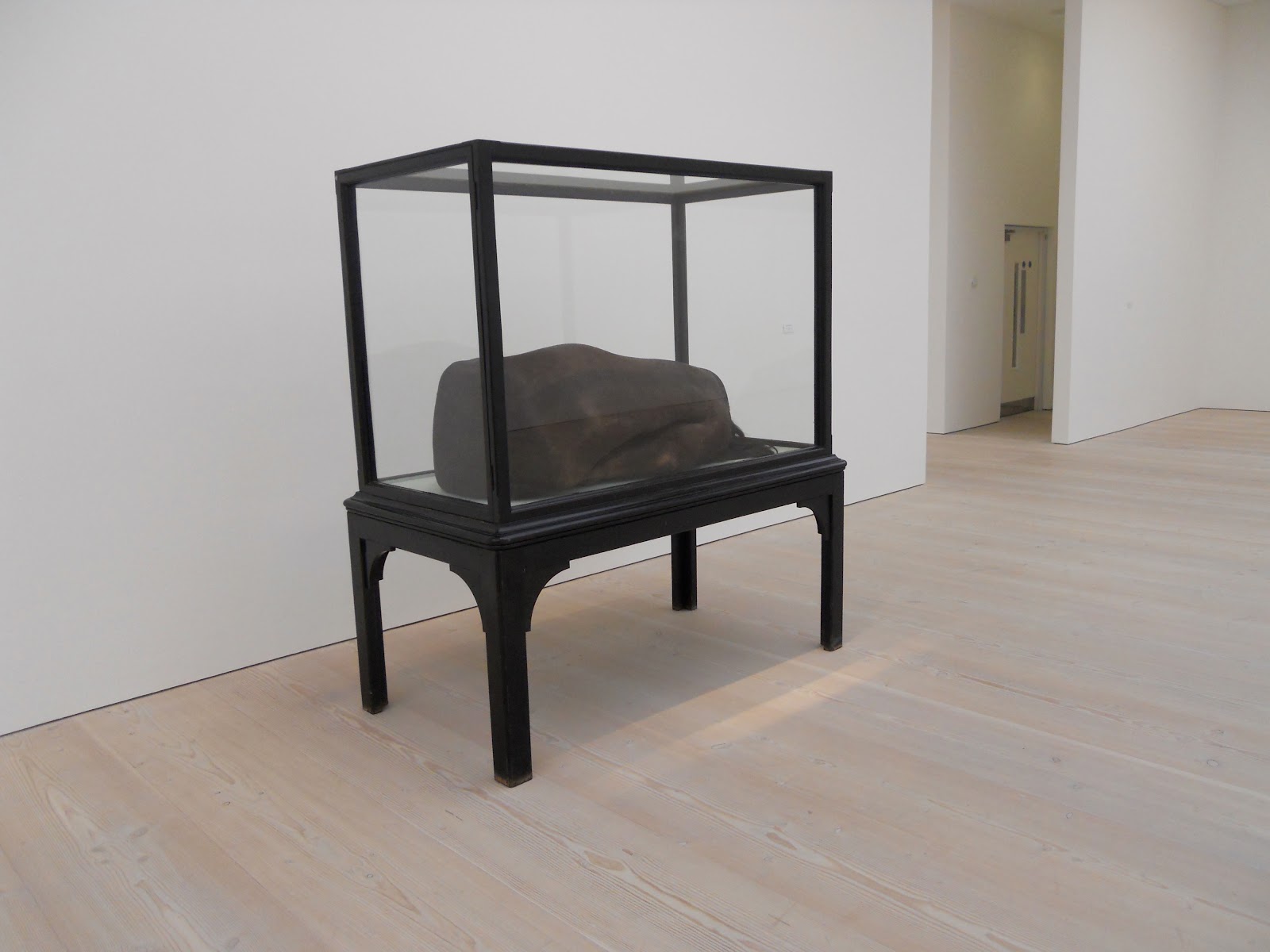
I've just returned from a marvellous week of theatre in London, where I also dropped into the Saatchi Gallery.  I immediately recognised the work of the Flemish artist Berlinde de Bruyckere, who I wrote about in a recent post.


While her horse in Zurich's Kunsthaus is gray, in the Saatchi Gallery she has two black horses. The first is headless and legless, a piece of beautiful meat, exhibited in a vitrine. The second has all of the beautiful curves of a Henry Moore sculpture, but the soft sheen of the coat lacks the hardness of bronze. The beauty of these horses brings an overwhelming sense of sadness. The fact that they are now naked to our observation gave me the same feeling of unease that I had when viewing the Egyptian Mummies in the British Museum.  It does seem obscene to be pleasantly walking about, viewing these magnificent creatures in their deathly silence and stillness.


De Bruyckere's third work, Marthe, is a sculpture in wax of a headless woman, standing in an open vitrine, her uterus gone, her guts poring out, one long arm extended, claw-like to the ground. There is something Ovidian about this transformation. The realism of the execution, with its whites, reds and blues, makes the image all the more horrifying.


It has often been said that art is always about love and death. De Bruyckere's work is certainly about death. The horses, in their silent deathliness, possess a terrible beauty. And the visceral, painful realism of Marthe, is a reminder of the fragilty of life, the presence of suffering.

Friday, June 3, 2011

Rodchenko and Ai Weiwei in Photography Museum, Winterthur

What a stroke of genius by the Photography Museum Winterthur, Switzerland, to run two parallel exhibitions, "Alexander Rodchenko - Revolution in Photography" and "Ai Weiwei-Interlacing".

photo:paul doolan
The Russian constructivist Alexander Rodchenko needs little introduction, having taken photos that  became such icons of the Russian communist revolution, that many of them now grace history textbooks worldwide, like his famous portrait "Pioneer" from 1930.

Alexander RodtschenkoPioneer girl, 1930
Gelatin-silver print, Vintage print
56 x 43,1 cm
Moscow House of Photography Museum
© Rodchenko’s Archive / 2011, ProLitteris, Zürich

Rodchenko became the leading spokesperson for those Russian avant guarde artists who threw in their lot with Lenin and the Bolsheviks and put their art in the service of the great cause of creating a world of peace and justice. Of course we know it turned into a totalitarian nightmare, against which Ai Weiwei is now one of the most famous current victims.  When we view Rodchenko's early, optimistic works, we are forced to admire his craftsmanship and his ingenious originality, but we inevitably see this through eyes laced with irony. Who can read Rodchenko's words "The camera lens is the eye of civilized man in a socialist society."(1928), and not be struck by a sense of sadness, knowing that this was the year Stalin commenced the first Five-Year Plan. It seems quite heartbreaking to read "My creative path has not been easy, but it is clear to me who I was and what I want. I am certain that in the future I will make genuine Soviet works" (1935), knowing that the year marks the beginning of the Great Purges and that the near future will mean the dismemberment of Lenin's original party, the murder of millions and a gigantic war against Nazi Germany that will kill 20,000,000 Russians.

Alexander Rodchenko
Caricature Showing Osip Brik, variant of a cover for LEF Magazine, 1924
Gelatin-silver print
24,2 x 17,9 cm
Private collection
© Rodchenko’s Archive /
2011, ProLitteris, Zurich

The career of Rodchenko draws inevitable comparison with that of the ingenious Russian film-maker Sergei Eisenstein.  Both seemed to have been obsessed with montage in their early work, both are idealists who put their work in the service of bringing about a political revolution, and both become disillusioned by that same revolution towards the end of their lives.

Alexander RodchenkoGirl with a Leica, 1934
Gelatin-silver print, Vintage print
45 x 29,5 cm
Private collection
© Rodchenko’s Archive /
2011, ProLitteris, Zurich


Ai Weiwei is another politically motivated artist, one who lives with the consequences of the victory of communism.  But unlike Rodchenko, instead of supporting the communist state, he has used his photos and film, in all their wonderful quirkiness, to attack the absurdity and hubris of state power.  The cost has been huge.  As part of this exhibition Ai Weiwei was supposed to give a talk in Winterthur last week - but as we all know by now, China's most internationally famous artist has disappeared into the Chinese labryint of oppression, having been arrested on April 3rd.

His "June 1994" must surely bring a smile to most faces, with the contrast between, on the one hand, the officials in uniform and the man standing stiffly for a photo outside the Forbidden City with its image of Chairman Mao, and, on the other hand, the pretty woman who faces us and raises her dress to give us a glimpse of her knickers. As I said, the irreverence will bring a smile to most, but certainly a scowl from the members of the Party.
Ai WeiweiJune 1994, 1994
C-print, 117,5 x 152 cm
© Ai Weiwei

And, as if to make sure that the message does not get lost, here is an image from his series "Study of Perspective":

Ai WeiweiStudy of Perspective – Tiananmen, 1995-2010
C-print, 32,5 x 43,5 cm
© Ai Weiwei

The most impressive part of this exhibition is when one steps into a large room to be surrounded by dozens a large coloured prints called "Provisional Landscapes".  These cityscapes are in transition (Provisional) because of the Chinese government's scorch-earth policy towards its own past and present. In its myopic drive towards the future and modernization it is willing to destroy entire neighbourhoods, an easy thing to do when the state owns all of the land.

Ai WeiweiProvisional Landscapes, 2002-2008
Diptych, Inkjet-prints, each 66 x 84 cm
© Ai Weiwei

This disregard for the past is captured by Ai Weiwei's self-portrait triptych "Dropping a Han-Dynasty Urn":
Ai Weiwei
Dropping a Han-Dynasty Urn, 1995
Triptych, C-prints, each 150 x 166 cm

I must admit to a sense of unease as I walked around this exhibition yesterday with my family. Having soaked in the images, we had lunch in the museum's Restaurant George.  The children bought a few souvenirs of the day. It was a wonderful way to spend Ascension Thursday. The unease came from knowing that Ai Weiwei has not been able to enjoy this. It is an outrage that, instead, he languishes in an unknown prison in China.

Tuesday, May 31, 2011

Dinner at the Volkshaus

As the academic year draws to a close last night a small group of teachers from my department decided to have dinner together. As the historians numbered three and economists only one, we decided to dine somewhere that offers good food and a sense of history (as opposed to the stock exchange). We picked Zurich’s recently renovated Volkshaus (People’s House) Restaurant. Founded over a hundred years ago to provide organized labour with a place to gather, during World War One it played host to a number of meetings involving Lenin, Kamenev, Zinoviev and other Bolshevik revolutionaries, as well as the Menshevik Trotsky (with a great feeling for timing, Trotsky switched to the Bolsheviks during the summer of 1917).  The Volkshaus is featured in Alexander Solzhenitsyn’s novel Lenin in Zurich.

Volkshaus Restaurant in Zurich: Did Lenin Eat Here?

Originally the restaurant was alcohol free (the philanthropic financiers of the project had decided that alcohol was bad for the workers), and served wholesome but cheap food.  These days the food is rather good, and anything but cheap. The building still hosts May Day meetings every year, and the square outside the building witnesses the occasional riot when the world's very concerned and very rich jet in for World Economic Forum in nearby Davos; but these days most people come for rock and jazz concerts, the disco, the sauna, the bookstore and the excellent food. From my observations of the well heeled clientele last night, the restaurant is no longer so popular with communist revolutionaries.

Friday, May 27, 2011

Cuno Amiet in the Kunsthaus

Some time ago I wrote about a visit to the Kunsthaus in Zurich and I showed this beautiful room, with the two Bonnards lining the entranceway and the Degas just beyond.


Last year the Kunsthaus celebrated its centenary and had this room restored to its original 1910 state. The Bonnards have been moved to a room nearby and the walls now display the paintings that hung here when the museum opened. The paintings are a series form the Swiss artist Cuno Amiet. The Degas can still be seen facing the entranceway. When Amiet's paintings were orginally exhibited they were considered to be very avant-garde and described by the local press as "hateful, brutal and sick".

Now it is as if the room has been frozen in time. I love the skylight, the carpet, the pillars, and though the paintings are less colourful than the Bonnards, the room does have a great sense of Jugendstil wholeness.

Sunday, May 22, 2011

Speechless Gray Horse


The horse's eyes are sown shut. Its mouth too. Its body is tightly bound with thin rope. Parts of its legs are missing. This horse lies, dismembered, yet peaceful, almost comforting, yet nightmarish, on the floor in Zürich's Kunsthaus. It is a work of art, "Speechless Gray Horse" (2004)  by the Flemish artist Berlinde de Bruyckere. Her pseudo-anatomical works, like this one, evoke thoughts of abuse and suffering. I am reminded of Picasso's Guernica. But Picasso's horse is screaming in silence, while Bruyckere's is almost sleeping.


Our newspapers fills our days with examples of abuse, our television news offer us glimpses of dismemberment, but we can simply switch channels. One moment it is a bomb in Pakistan or the war in Afghanistan, next it is Desperate Housewives.  Bruyckere's work is disturbing. There are people who find her "Speechless Gray Horse" disgusting, but have no opinion on NATO's war in Afghanistan; a war fought in their name, financed by their taxes.  Now, that is disturbing.

Saturday, May 14, 2011

Anselm Kiefer's Parsifal in Zurich

To my delight, my nine year old suggested last Saturday that we should visit the Kunsthaus together. Saturday morning turns out to be an ideal time to visit; it was like we had the museum to ourselves.  Here is a photo of my daughter standing next to a great painting: Parsifal by Anselm Kiefer, painted on paper using oils and blood. You can see that it is a very large, monumental work. It is from a series of four, the other three being in the Tate Modern in London. Though photographs of the other three are widely available, this one, the largest, is more rare.


Those of you who read my blog regularly (I think that's a total of one or two) will know that I am a fan of Richard Wagner. So I was happy when I discovered some years ago this painting, that brings together one of my favourite composers with one of my favourite artists. Parsifal is, of course, Wagner's last opera, the idea of which, by coinicidence, he concieved on Good Friday in Zurich in 1857.

Anselm Kiefer's Parsifal, is not a light, joyful painting; none of his work is.  Indeed I suppose you could accuse Kiefer, like Wagner, of being a bit on the heavy side.  Kiefer was born in the Year Zero of German history, that is, 1945, just a month before the suicide of Adolf Hitler.  As Kiefer once said, his life is the story of Germany. The painting is of his atelier, marked by ominous shadows in the foreground, and the immense wooden rafters and planks leave one in no doubt that this is a space constructed of wood. The painting has got great texture, tempting one to reach out and touch it.  If I did, I imagine I would feel the splinters from the wood. For me, the space represents the primeval wood or mythical forest from which German legend and history arose. All of Kiefer's work is about this - what it means to be German, the roots out of which Germanhood arose, and the pivot around which all of German history revolves - the Holocaust.  All German kultur - the stories collected by the Grimm brothers, the philosophy of Hegel, the operas of Wagner - lead to the twelve years of insanity, when Germans gave away their freedom and the greatest crime in Europe's bloody history was committed, and scarred the continent's past, present and future.

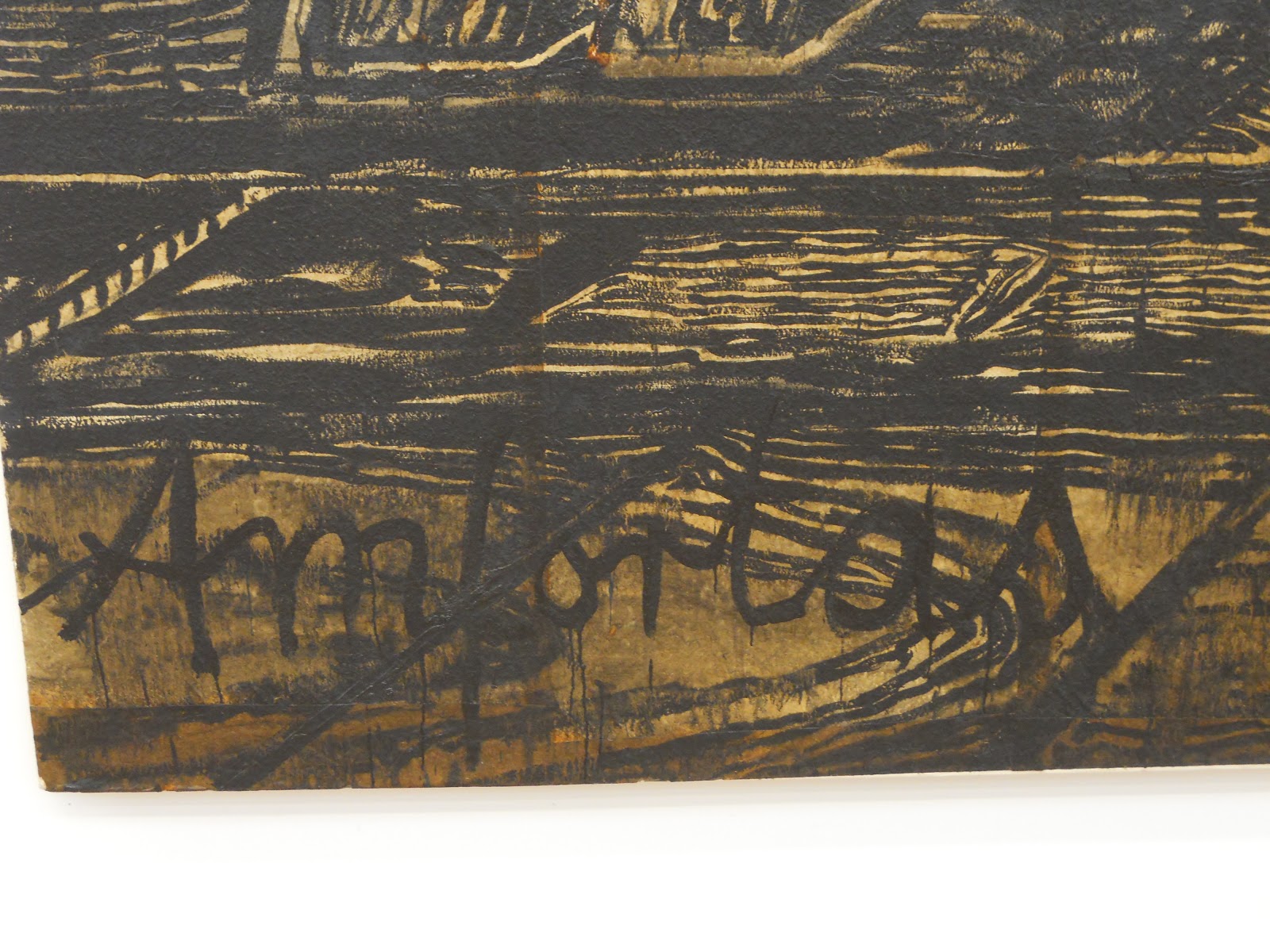
At the top of the painting Kiefer has painted the name Parsifal, while in the bottom left hand corner he has painted the name Amfortas,scrawled like the signatures of forgotten prisoners locked in some nightmarish attic space.


According to medieval German legend Parsifal, the innocent, wonderful fool, sets out to find the Holy Grail. Amfortas, the sinner, is suffering from a spear wound that bleeds continuously. For Kiefer, the genocide of Jews and Gypsies remains the open wound that still festers and poisons our view of German history. In the centre of the painting we find the Parsifal's Holy Grail.  Kiefer has painted the closing words of Wagner's Parsifal:  "Höchsten Heiles Wunder! Erlosung dem Erloser!" or "Highest Miracle of Salvation! Redemption of the Redeemer" above the Grail. But Kiefer's Grail mock's Wagner's words, as it sits on a wooden stool, dripping blood, real blood. The unredemptive blood spilt by German history.


Like any great artist, Anselm Kiefer is an alchemist. He breaks down the boundaries between myth and history, the past and the future, literature, music and politics, and turns them into something more precious than gold: art that goes to the core of the human condition.