Showing posts with label Kunsthaus. Show all posts

Sunday, August 23, 2015

Zurich's Kunsthaus Could be the Receiver of Stolen Jewish Art.

Manet, La Sultana (Photo: Wikimedia Commons)
Sometime ago I wrote about the new extension planned for Zurich's Kunsthaus, designed by the British architect David Chipperfield. The extension will house the impressive Bürhle collection, part of which was last exhibited a few years ago at the Kunsthaus. The collection will, when opened to the public in 2020, torpedo Zurich's Kunsthaus into the top tier for public collections of French Impressionism. In fact, Zurich will be second only to Paris.  But tomorrow a book will be published from which the fallout is sure to complicate matters.


During the past few decades most major art museums have been forced to audit their collections, or at least give an impression they are doing so, in order to ascertain whether they hold any art that was wrongfully taken from Jewish owners during the era of Nazi rule in Europe. This can be in the form of art that was simply robbed by the Nazis, or art that was bought by an innovative collector at knock-down prices because the unfortunate Jewish owners, fleeing from the Nazis, were being forced to sell.

A couple of years ago the world was intrigued by the Cornelius Gurlitt story, when over 1,000 formerly Jewish owned works of art were discovered in an apartment in Munich. Gurlitt has since died and, for some strange reason, he bequeathed his collection to an art museum in Bern. This was a nice windfall for the museum, but brought rather a lot of unwanted attention - was Switzerland simply going to accept a gift, even when the gift is stained with Jewish blood?

Cezanne, Paysage (Photo: Wikimedia Commons)
The new book that will appear in bookstores tomorrow, Schwarzbuch Bührle [Blackbook Bührle] makes the argument that the Kunsthaus might be the receiver of stolen goods via the controversial Bürhle collection. The fact that the industrialist Bürhle supplied Nazi Germany with weapons is already somewhat embarrassing, but now the Kunsthaus will have to deal with this added complication. The grave accusations will certainly lead to further public discussion as co-editor and one of the authors of the book is Guido Magnaguagno, who happens to have once been Vice-Director of the Kunsthaus. The opinions of this esteemed art historian and museum leader will be taken seriously. Indeed the pending appearance of his book has already made front page news in Switzerland this weekend.


In the new book Magnaguagno lists 12 works that are particularly suspicious because of the so called gaps in provenance, works from Cezanne, Courbet, Manet, Utrillo, Monet, Van Gogh, Modigliani, Kalf, Braque and Corot. No doubt we will hear a lot more about this before the new extension opens in 2020.
Monet, Poppy-fields at Vetheuil (Photo: Wikimedia Commons)

Saturday, April 21, 2012

Winter Tales

Paris, 2012


I've certainly noticed some weirding of the weather in recent months.  First there was Europe's seemingly endless mild autumn, with balmy temperatures that ran right into December. Even Switzerland experienced a drought - seven weeks without precipitation. Then, suddenly the great freeze descended on most of northern Europe, enveloping the continent in sub-zero temperatures for seven or eight weeks - literally, a cold that killed. I don't think I ever experienced such a prolonged period of sub-zero temperatures in my life. It was followed by what seemed like an early summer in March.  For weeks we dined on our patio every evening, enjoying temperatures of over 20 degrees. Spring had been skipped.  And then, along came now - a reversion to early spring - in late April!  Some sunny spells, lots of scattered showers, and I'm wearing my overcoat again. Of course Chaucer had written of this over 600 years ago:

                                   Whan that aprill with his shoures soote
                                   The droghte of march hath perced to the roote

And T.S.Eliot, writing in the shadow of the 20th century's Great War, had warned us that:


April is the cruellest month, breeding
Lilacs out of the dead land, mixing
Memory and desire, stirring
Dull roots with spring rain.


But neither  mentioned that March is hot, and late April is cold.

In February, during the great freeze, I took the train to Paris for a history conference.  It was so cold, they even had to cancel the Ireland-France rugby match because the pitch was frozen - no joke for the 10,000 Irish fans who had made the journey.  But what struck me were the homeless in Paris and the soup kitchens on the street.  The Canal Saint Martin looks pretty when it is frozen, but the homeless huddled in blankets in doorways showed how brutal urban life can be. On a Saturday night I mixed with the revelers on the Place de la Bastille and noticed an entire family, mother, father and two children, huddled inside a telephone box, wrapped in sleeping bags.. As I returned to my hotel that night I shuffled past a couple of dozen muffled and silent men and women eating soup that had been handed out by volunteers; the temperature was around ten degrees below zero.


Paris, 2012

A couple of days after returning to Zurich I visited the exhibition in the Kunsthaus "Winter Tales". The exhibtion has been organized in collaboration with Vienna's Kunsthistorisches Museum. I enjoyed it immensely.  Not only can the exhibition boast of a number of startling and surprising works, but it possesses a great narrative power that carried me along.  Winter was once a time to be feared, with freezing temperatures and food supplies imperiled, but this exhibition lets us see how the dark season was tamed and, especially among the democratic Dutch, how the winter became a time for all, rich and poor, high and low, adult and child, to hit the ice and enjoy skating, either as a participant or just as an observer enjoying the spectacle.

Pieter Brueghel the Younger, 1601

During the Enlightenment the act of skating had become a symbol of freedom. The bourgeois citizen could enjoy his leisure time, but it is with the onset of the French Revolution (that brings the middle class burgher to power), that he can really swing his arms in freedom as he skates away on the thin ice of a new age, like a living, dynamic and daring statue of liberty, top hat and all.

Pierre Maximilien Delafonteine, 1798


Of course the spectacular ferocity of the Russian winter that ravaged Napoleon's army ignited the interest and retained the attention of the romantics for some decades.

Boissard de Boisdenier, 1835

However, by the end of the 19th century winter seemed to have been tamed, providing Monet simply with an excuse to challenge himself and create a study in white, a study of the act of painting itself - white on white, with the single black object, "The Magpie".

Monet, 1869
And winter provided Munch with the opportunity to paint, well, what else, but Munch (did he ever paint anything else?); the gnarled Norwegian winter landscape as a self portrait, a mirror of the anguished state of mind of the self-obsessed artist.

Munch, 1900

Of course history is never linear. No true narrative travels in a straight line. Winter had not been tamed for everyone. Winter had not become simply a playground, or or an excuse to experiment in painting or to indulge in self-analysis.  As always, they still had the poor.

Fritz von Uhde, 1890
In Fritz von Uhde's painting "A Difficult Walk (Walking Towards Bethlehem"), we are reminded that in late 19th century Europe, after decades of industrial progress, Mary and Joseph still walked the streets of winter looking for a place at the inn. 

And the poor are still in our midst in the glitzy, consumerist and technologically smart 21st century. In many of Europe's large urban areas this winter, like on the streets of Paris, places at the inn were limited.

Monday, December 12, 2011

The Nahmad Collection at Zurich's Kunsthaus

If you’ve never heard of the Nahmad Collection, don’t worry, you can be forgiven. After all, although it is one of Europe’s most prestigious private art collections, it is not greatly known, never having been exhibited in public. That is, never until now. The exhibition currently showing at the Kunsthaus in Zurich is quite a coup, being the first ever exhibition of a portion (nearly 120 paintings) of this enigmatic collection. Zurich’s Kunsthaus is now firmly on the path of building a reputation for exhibiting the works of private collectors. Beginning with A Feast of Colours in 2006, which featured the Merzbacher-Mayer collection, and continuing with the incredible Buehrle Collection (which has now been donated to the Kunsthaus and will reappear in a permanent exhibition in the new David Chipperfield wing in 2015), the presentation of the Nahmad Collection, entitled Monet, Mattise , Miro, is the third such exhibition in recent years. We picked a Sunday afternoon in late November. The sun radiated unseasonable warmth from a brilliant Japanese winter blue sky. We guessed correctly that most Swiss would strap on their hiking boots or saddle up their mountain bikes and head for the hills and forests on such a beautiful day. It could have been a Monday morning – one could contemplate the seven Modigliani’s in silence, stand before the Toulous- Lautrecs without being elbowed, view the single Bonnard portrait without having to first wait in a line. The exhibition begins with late 19th century Post-Impressionism and then takes us through a selection of highlights from most of the major modernist movements – Fauvism, Cubism, Abstractism, Constructivism and Surrealism. The Monets mostly are southern scenes, for instance of Venice, like this one of The Contarini Palace that evokes the city’s frayed splendor.


One room contains five Kandinskys, all of which are interesting, most of which are abstract, though I must admit my favourite is this still (just about) figurative “Study for Improvisation 3”, though I do find the title an oxymoron – can one have a study for an improvisation?
 

The Modiglianis are superb and it is a special experience seeing seven of his portraits on one wall, facing a half dozen works of Mattisse. But if seven Modiglianis seems like a lot, the exhibition contains no fewer than 13 Miros, all of them major works and spanning the artists entire career, and 30 Picassos from the early 20th century until the year of the artist's death in 1973, including his famous “Portrait of the Artist’s Son, Paulo, as Harlequin”, a painting that hasn’t been seen in public for decades.


But this is simply the tip of a hidden iceberg. The Nahmads are a Jewish family, originally from Aleppo, Syria. They moved to Beirut in the late forties and to Milan in the late fifties, accumulating fortune of well over 3 billion dollars through art dealing. The family currently resides in Monaco, for tax reasons I suspect, and have art galleries on Madison Avenue in New York and Cork Street in London. The family’s entire private collection consists of about 3,000 paintings and includes hundreds of works of Picasso. They keep their collection hidden away in an underground storage facility in Geneva where it is rarely viewed by any human eye. This might seem obscene to you. Perhaps the exhibition in the Kunsthaus in Zurich can be considered the secretive family’s “coming out”.

The exhibition runs until January 15th when, presumably, all of these fine works disappear again.

Friday, May 27, 2011

Cuno Amiet in the Kunsthaus

Some time ago I wrote about a visit to the Kunsthaus in Zurich and I showed this beautiful room, with the two Bonnards lining the entranceway and the Degas just beyond.


Last year the Kunsthaus celebrated its centenary and had this room restored to its original 1910 state. The Bonnards have been moved to a room nearby and the walls now display the paintings that hung here when the museum opened. The paintings are a series form the Swiss artist Cuno Amiet. The Degas can still be seen facing the entranceway. When Amiet's paintings were orginally exhibited they were considered to be very avant-garde and described by the local press as "hateful, brutal and sick".

Now it is as if the room has been frozen in time. I love the skylight, the carpet, the pillars, and though the paintings are less colourful than the Bonnards, the room does have a great sense of Jugendstil wholeness.

Saturday, May 14, 2011

Anselm Kiefer's Parsifal in Zurich

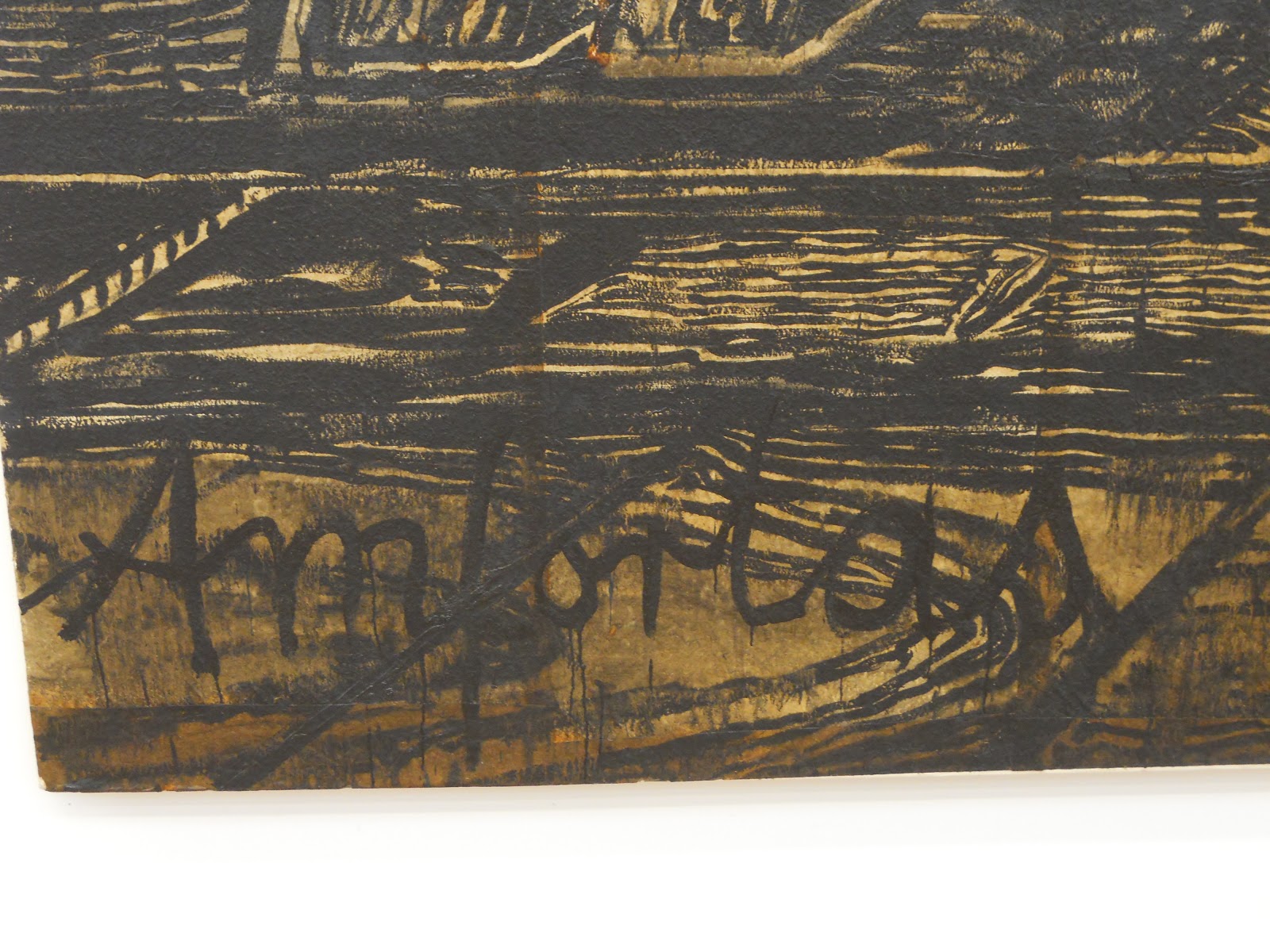
To my delight, my nine year old suggested last Saturday that we should visit the Kunsthaus together. Saturday morning turns out to be an ideal time to visit; it was like we had the museum to ourselves.  Here is a photo of my daughter standing next to a great painting: Parsifal by Anselm Kiefer, painted on paper using oils and blood. You can see that it is a very large, monumental work. It is from a series of four, the other three being in the Tate Modern in London. Though photographs of the other three are widely available, this one, the largest, is more rare.


Those of you who read my blog regularly (I think that's a total of one or two) will know that I am a fan of Richard Wagner. So I was happy when I discovered some years ago this painting, that brings together one of my favourite composers with one of my favourite artists. Parsifal is, of course, Wagner's last opera, the idea of which, by coinicidence, he concieved on Good Friday in Zurich in 1857.

Anselm Kiefer's Parsifal, is not a light, joyful painting; none of his work is.  Indeed I suppose you could accuse Kiefer, like Wagner, of being a bit on the heavy side.  Kiefer was born in the Year Zero of German history, that is, 1945, just a month before the suicide of Adolf Hitler.  As Kiefer once said, his life is the story of Germany. The painting is of his atelier, marked by ominous shadows in the foreground, and the immense wooden rafters and planks leave one in no doubt that this is a space constructed of wood. The painting has got great texture, tempting one to reach out and touch it.  If I did, I imagine I would feel the splinters from the wood. For me, the space represents the primeval wood or mythical forest from which German legend and history arose. All of Kiefer's work is about this - what it means to be German, the roots out of which Germanhood arose, and the pivot around which all of German history revolves - the Holocaust.  All German kultur - the stories collected by the Grimm brothers, the philosophy of Hegel, the operas of Wagner - lead to the twelve years of insanity, when Germans gave away their freedom and the greatest crime in Europe's bloody history was committed, and scarred the continent's past, present and future.

At the top of the painting Kiefer has painted the name Parsifal, while in the bottom left hand corner he has painted the name Amfortas,scrawled like the signatures of forgotten prisoners locked in some nightmarish attic space.


According to medieval German legend Parsifal, the innocent, wonderful fool, sets out to find the Holy Grail. Amfortas, the sinner, is suffering from a spear wound that bleeds continuously. For Kiefer, the genocide of Jews and Gypsies remains the open wound that still festers and poisons our view of German history. In the centre of the painting we find the Parsifal's Holy Grail.  Kiefer has painted the closing words of Wagner's Parsifal:  "Höchsten Heiles Wunder! Erlosung dem Erloser!" or "Highest Miracle of Salvation! Redemption of the Redeemer" above the Grail. But Kiefer's Grail mock's Wagner's words, as it sits on a wooden stool, dripping blood, real blood. The unredemptive blood spilt by German history.


Like any great artist, Anselm Kiefer is an alchemist. He breaks down the boundaries between myth and history, the past and the future, literature, music and politics, and turns them into something more precious than gold: art that goes to the core of the human condition.


Thursday, February 24, 2011

David Chipperfield in Zürich

British architect David Chipperfield was recently awarded the Royal Gold Medal for his services to architecture. This is the latest of a series of honours, including a knighthood, that the 57 year old has received.  Nevertheless, the modest Englishman is not a household name; he is not one of the dozen or so cosmopolitan Starchitects, like Foster, HadidKoolhaas, Libeskind, Gehry, Calvatrava or Herzog and de Meuron, whose buildings, by their sheer audacity but also by their irreverent isolation from the historical and social context that surrounds them, have established themselves as icons of the postmodern world. Chipperfield's works are generally characterised by a lucid austerity and creative restraint.  It is his thoughtfulness and faithfulness to place that gained him the commission to restore the Neues Museum on Berlin's museum island.  The result demonstrates how David Chipperfield put modest conservation before eye-catching innovation.

Neues Museum Berlin

His Museum of Modern Literature in Marbach, Germany, is clearly a nod to the great European classical tradition that stretches back from today to antiquity.  The design was controversial because in Germany classical columns have strong and immediate echoes of Nazism's megalomaniacal architectural fantasies.  But Chipperfield's is a classicism that is almost homely, and reflects a homage to Palladio rather than Hitler. This is a modest house for literature.


Museum of Modern Literature Marbach, Germany

Museum of Modern Literature Marbach

In 2008 David Chipperfield won the competition to become the architect of the extension to Zürich's Kunsthaus.  The project is to be completed by 2015 and the new extension will house the wonderful Bührle Collection. Chipperfield was in Zürich earlier this month and talked about his plans for the Kunsthaus. As reported by the newspaper the Tages-Anzeiger, someone from the public remarked that it seemed like the extension was going to be a very big building. "Yes, it's a big building. It's a museum" Chipperfield answered. The new building will be across from the old building, creating a museum square, and behind the new building there will be a large garden. Why, he was asked, wasn't the new building further away from the old building, which would leave a big square? He answered that then you would get "a small garden and a stupid square".  For me the key question was, had he designed this new building specifically for Zürich?  He answered that he had not deliberately imitated anything typically Zürich or Swiss, but he had developed something that suits Zürich, because it is a quiet building. He concluded: "Zürich is a solid city, not Barcelona. It's a Zürich building."

I have earlier written on the major contemporary world architects who: 

"take no account of the context, or the local, when designing their artworks. The buildings are meant to stand out, not to blend in, and are consequently designed with an absolute disregard for the local context. That’s why they would be equally at home anywhere, because they are at home nowhere."

David Chipperfied is an architect, I suspect, whose buildings are not outsized by his ego. It is so nice to find an architect who studies the urban environment before he stamps it with his idea.

Planned extension of Kunsthaus

Old Kunsthaus on the left, Chipperfield's extension on the right

Read more essays like this in my ebook about Zurich.

Saturday, September 4, 2010

Three of My Favourite Rooms

I stole an hour from my usual routine yesterday and dropped in to the Kunsthaus for an hour.  Ignoring the exhibitions I headed for the museum’s permanent collection and, to my delight, three of my favourite rooms were completely empty.  What a way to spend a leisurely hour. 


I love this large room, lit by natural light coming through the glass ceiling.  The room itself is a work of art, with its original Jugendstil decorations.  Even the sofas look like works of art, but they are for sitting on.  The paintings on both walls, surrounding a statue from Rodin, are all from Edvard Munch.  This is, I believe, the largest public collection of Munch paintings outside of Norway.

These works, like Russian dolls, carry within them many shapes and hidden messages.  Sometimes a particular painting has something of Cezanne and the Cubists, but at another viewing Derain and the Fauvists suddenly appear. Perhaps it is characteristic of Munch, perhaps it is the light, or the room, or simply a change in my mood, but the paintings are never quiet stable, and so I return to them often.


Munch is not my favourite artist. His paintings are filled with his own angst, his self-obsessions, his own particular sufferings.  Munch’s famous attempt at suicide is ridiculously comic – he shot himself in his fingertip.  This gave him fodder for years and years of self-indulgent whining.  Such histrionics. His most famous painting, “The Scream” is partly horrifying but mainly just silly.  It’s no wonder that Munch appeals to tattooed, tormented teenagers dressed in black.  One only hopes they’ll grow out of it.

         Edvard Munch, Portrait of Albert Kollman, 1943-'44

And yet, for all that, he was a gifted painter and even, to a limited extent, a visionary.  I try to forget his ludicrously self-pitying personality, and focus on the paintings themselves, especially in this beautifully calm setting.


The second room is not really a room at all, but a passage between two rooms.  Again, the ceiling and walls are decorated in Jugendstil fashion. On either side of the doorway are two tall and narrow Japanesque paintings by Bonnard. They come from his Nabis period. The colours are intense, created with tiny brush strokes, and radiate a sense of calm beauty. The doorway frames the Degas painting of a bather, hung on a golden wall.  All three paintings are so perfectly placed, it is as if they belong right here. I cannot imagine them ever finding a better home.  This space is perfect.


The third room contains three of Monet’s giant water lilies paintings.  But the room contains a number of Rodin’s statues as well – that is the genius of this room.  I don’t know whose idea it was to drop five Rodins in among three Monets, but the effect is unique.  I can sit on the seat provided and stare at the Monets or Rodins, or walk around the room and study the works from various vantage points. I even kneel next to Rodin’s “Martyr” and stare into her dead eyes:


I get up close to a Monet:


 and closer,


 closer still, 

until the painting is no longer in focus,


and then I study the Monets while looking over the shoulder of a Rodin:


One can imagine having a small group of students here, and have them explore the various viewpoints.  Even better is to have the room to oneself on a sunny Friday morning.