 |
| Spain 1937 |
When I turn the photo over I see printed on it the words "Post Card" and "Jerome Ltd.". Someone has written on the card in pencil, and I can vaguely make out the words "first spade, and hearts". There follow four columns under C, S, D and H. Each column has a series of numbers. Perhaps someone has been playing bridge.
I found the photo in a box of my father's old photos. I have no doubt that it was taken in Spain in 1937. At a guess I would say that the three men in uniform are all Irishmen who, for whatever reason, have joined General Franco's forces. Perhaps the man standing on the far left is Irish too. But the other three are not in uniform, two of them even clad in suits. Local lads, I would guess, posing for a photo with the exotic foreigners who have volunteered to fight in another man's war. What is the story behind the photo? We will never know now, and there is little doubt that all of the men in this photo are now dead.
I know the place and date of the photo because I recognise one of the men, the one in the centre, casually sitting, legs crossed - my father.
Men go to war for many reasons - to avenge a slight, to defend their property and their loved ones, but most often, alas, simply to fulfill their duty. The Spanish Civil War, that raged between 1936 and 1939 and consumed a half a million lives and locked the country in a stifling cage for four decades, was unique however, for it attracted tens of thousands of young idealistic men from all over the world to its carnage. Most, like George Orwell, Arthur Koestler and Laurie Lee, went to Spain to defend some form of socialism. A few, like my father, volunteered to fight on the other side, the side of the Fascist party, the side of the military rebels, the side of the catholic Church. Fifty years after the outbreak of the war my father wrote that he had volunteered to fight in order to defend religious freedom. What amazes me is that many of these men had never touched a gun before, had never been to Spain, spoke no Spanish and knew little about the country's history. Instead they allowed themselves to be convinced by the righteousness of their belief to the extent that they were willing to travel to a distant country, take up a weapon, and kill.
Here is another photo. A group of my father's Christian comrades, together with a catholic priest. In their minds, and mostly in their hearts, the killing that they had volunteered to do was God's work.
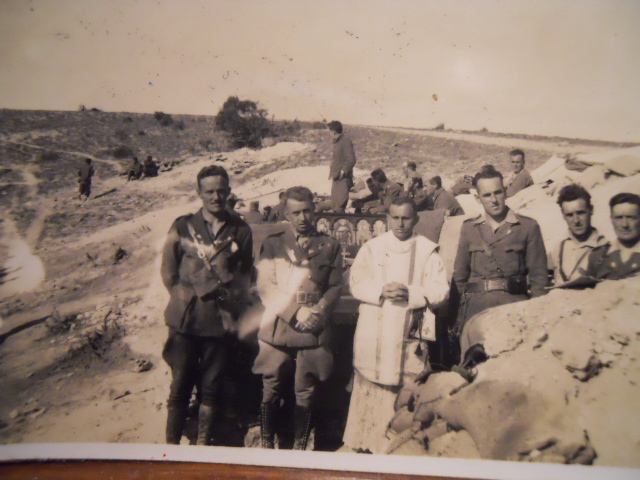 |
| Irish officers and catholic priest in Spain |
My father's box of photo, also contains pamphlets from the time. Most of them contain the words "Holy Crusade". One of them is called "Ten things you need to know about the Dangers of Atheistic Communism". The words "Red" and "Evil" appear frequently. The enemy is Godless, so the enemy is an enemy of God. Having turned against God, they have turned against humanity; having lost God, they have lost their humanity. And so my father took up his gun and went to fight the enemies of God.
At the bottom of my father's box I found a framed Certificate of Service, it looked like some sort of diploma. When he was alive he never displayed it. Instead, it lay for years at the bottom of a box. It contains my father's name: Matt J. Doolan. General Duffy, leader of the right-wing Blueshirts, (of which my father was a member) and leader of the Irish Brigade in Spain, has signed it in the bottom right hand corner. Above O'Duffy's is another another signature, that of the Generalissimo himself. Just below the entwined Irish and Papal flags you can read "Crusade in Spain 1936-37". That was the cause for which my father risked his life and, alas, the risked the lives of others.
 |
| Certificate of Service for Matt J. Doolan |

