Showing posts with label Switzerland. Show all posts

Sunday, August 23, 2015

Zurich's Kunsthaus Could be the Receiver of Stolen Jewish Art.

Manet, La Sultana (Photo: Wikimedia Commons)
Sometime ago I wrote about the new extension planned for Zurich's Kunsthaus, designed by the British architect David Chipperfield. The extension will house the impressive Bürhle collection, part of which was last exhibited a few years ago at the Kunsthaus. The collection will, when opened to the public in 2020, torpedo Zurich's Kunsthaus into the top tier for public collections of French Impressionism. In fact, Zurich will be second only to Paris.  But tomorrow a book will be published from which the fallout is sure to complicate matters.


During the past few decades most major art museums have been forced to audit their collections, or at least give an impression they are doing so, in order to ascertain whether they hold any art that was wrongfully taken from Jewish owners during the era of Nazi rule in Europe. This can be in the form of art that was simply robbed by the Nazis, or art that was bought by an innovative collector at knock-down prices because the unfortunate Jewish owners, fleeing from the Nazis, were being forced to sell.

A couple of years ago the world was intrigued by the Cornelius Gurlitt story, when over 1,000 formerly Jewish owned works of art were discovered in an apartment in Munich. Gurlitt has since died and, for some strange reason, he bequeathed his collection to an art museum in Bern. This was a nice windfall for the museum, but brought rather a lot of unwanted attention - was Switzerland simply going to accept a gift, even when the gift is stained with Jewish blood?

Cezanne, Paysage (Photo: Wikimedia Commons)
The new book that will appear in bookstores tomorrow, Schwarzbuch Bührle [Blackbook Bührle] makes the argument that the Kunsthaus might be the receiver of stolen goods via the controversial Bürhle collection. The fact that the industrialist Bürhle supplied Nazi Germany with weapons is already somewhat embarrassing, but now the Kunsthaus will have to deal with this added complication. The grave accusations will certainly lead to further public discussion as co-editor and one of the authors of the book is Guido Magnaguagno, who happens to have once been Vice-Director of the Kunsthaus. The opinions of this esteemed art historian and museum leader will be taken seriously. Indeed the pending appearance of his book has already made front page news in Switzerland this weekend.


In the new book Magnaguagno lists 12 works that are particularly suspicious because of the so called gaps in provenance, works from Cezanne, Courbet, Manet, Utrillo, Monet, Van Gogh, Modigliani, Kalf, Braque and Corot. No doubt we will hear a lot more about this before the new extension opens in 2020.
Monet, Poppy-fields at Vetheuil (Photo: Wikimedia Commons)

Friday, June 26, 2015

One Hundred Days by Lukas Barfuss

Lukas Barfüss, One Hundred Days (Granta Books, 2013)

I’m sure you’ll agree, translators are the nicest people in the world, (teachers excepted of course). Just think about it, some poor, asocial sucker, with the loneliest job in the world, has spent the past year or so locked up in a room writing a book.  Along comes the translator and, in return for a pittance, sits for the best part of half a year or so locked up in a room and miraculously turns the foreign words into something you can understand, thereby allowing you to break out of the narrow-minded parochialism that comes with being an English speaker and actually hear what other people (the majority) are saying in other languages. So three cheers for Tess Lewis (whoever she is), for translating the novel One Hundred Days by the young Swiss author Lukas Barfüss.

In this contemporary version of Conrad’s Heart of Darkness, steamy sex and genocidal murder make for a potent mix, told in deceptively simple, taut prose. The protagonist is a naïve chap by the name of David Hohl. He has always been moved to fight against injustice. Had he gone to Zurich International School he would have won the ZIS Cares Award. So he gets a job in economic development and his first post is in the sleepy African backwater of Rwanda. But, the surface is deceptive and Rwanda is about to explode into the 1994 well planned genocide of Tutsis. In the one hundred days of the title the Hutus slaughter nearly 800,000 people. Because he is obsessed with a beautiful, but racist Hutu woman, David Hohl refuses to be evacuated, and instead stays and witnesses the slaughter. No wonder his name is Hohl (which means hollow).

Barfüss reveals the hypocrisy that lies at the root of Swiss development work. His book is a meditation on how a strong sense of virtue can gently lead to passive participation in the most horrifying cruelty. Most of all, his book works as a metaphoric warning against being sucked into any organisation that comes to see efficiency as an end in itself - surely a lesson for us all. Peaceful, well organised Rwanda was sometimes called the Switzerland of Africa. Barfüss sees that you can reverse this, seeing Switzerland as the Rwanda of Europe. He reminds us that Switzerland is a well-oiled machine that runs smoothly, where order, routine, discipline and respect for institutions holds sway, but adds: “These characteristics are not impediments to mass murder, but necessary conditions. Evil loves nothing more than the proper implementation of a plan, and in that domain, you have to admit, we are world champions.”


This book has garnered Barfüss a number of literary prizes, as well as nominations for the biggest book prizes in Germany and Switzerland. He is, of course, almost unheard of in the insular, provincial English speaking world.

Sunday, August 25, 2013

New ebook

I published my first e-book the other day. So, if you have a kindle, iPhone or iPad, you can purchase it for $3:99 at any amazon store. The book is called James Joyce and Zurich's Fair City - And other historical reflections on Switzerland..It collects a number of published and unpublished essays and, as the blurb says "offers a series of anecdotal historical essays that will enhance your stay in Switzerland's beautiful city of Zurich. Stagger in the footsteps of James Joyce, drop in at the zany Cabaret Voltaire, get to grips with the philosophy behind Wagner's operas, discover Zurich's connections with Tom Waits, Thomas Mann, Will Self, Herman Hesse, Empress Sissi and many more.

Get you copy at this link now before it sells out!

Tuesday, February 19, 2013

Medusa in Zurich

I am just strolling out of a car park in Zurich this week, on my way to the marvelous Chagall painting exhibition at the Kunsthaus, when I see an eye-catching post. A young woman has has been decapitated and her head is placed on a circular plate. Spaghetti frames her head, like blond snakes emerging from her hair.

Elena or Medusa
 It is simply an advertisement for this DJ's show, "Elena zum Zmittag", on a popular local radio station.  If you visit the website of the radio station, you find that there are, in fact three such posters, each featuring a different DJ.  One of the DJs, the local celebrity Jonthsch, is a former student of mine.

Earlier this month I spent a few days in Florence with five of my students.  At the end of the trip I asked the students to name the one art work that made the deepest impression. One student picked Caravaggio's Medusa. He was impressed by its almost surreal hyper-realism. Caravaggio painted Medusa's decapitated head on canvas, mounted on a circular shield, the snakes of her hair coiling convulsively. In his recent biography of the artists Andrew Graham-Dixon describes the painting as "a work of such flourish and bravado that it has the look of a painting submitted for a prize." (Andrew Graham-Dixon, Caravaggio: A Life Sacred and Profane, Penguin Books, 2011, p. 157)

Caravaggio: Medusa
I don't know if the radio station deliberately referenced the Caravaggio work, but the connection seems clear to me and I like to think that it is an example of the memory provoked by an art work emerging in contemporary advertising.  What do you think?

Wednesday, January 9, 2013

Put down, but never discarded

There are books, read in youth, the content of which we still remember decades later. And there are books, of which the act of reading itself can be vividly recalled as if it were yesterday. It was July 1980. I had been travelling for three years. In the multitudinous din that was India, I was alone. Emaciated, jaded and worryingly low on funds, I arrived in the holy city of Madurai. Near the grand temple I found a room in a cheap hotel, a loveless place called Venus...

If you would like to read the rest of my article which appeared in Australia this morning, just click here.

Saturday, July 21, 2012

Art and the City: Taoyo Onorato and Nico Krebs - Camera

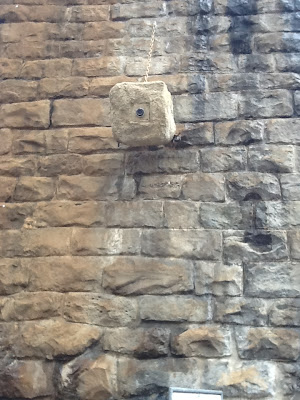
One of the exhibits at the Art and the City exhibtion running from June 7th until September 23rd in Zurich, Switzerland is from Swiss artist duo and Taiyo Onorato and Nico Krebs and is called Camera.
Camera by Taiyo Onotaro and Nico Krebs
"The distinguishing features of film lie not only in the way man presents himself to the camera but in how, using the camera, he presents his surroundings to himself." Walter Benjamin, The Work of Art in the Age of Mechanical Reproduction. (1936)

Friday, July 20, 2012

Art and the City: Franziska Furter - Mojo

One of the exhibits at the Art and the City exhibtion running from June 7th until September 23rd in Zurich, Switzerland is from Swiss artist Franziska Furter and is called Mojo.

Mojo by Franziska Furter
"As individual instances of artistic production become emancipated from the context of religious ritual, opportunities for displaying the product increase." Walter Benjamin, The Work of Art in the Age of Mechanical Reproduction.(1936)


Thursday, July 19, 2012

Art and the City: Charlotte Posenenske - Vierkantrohre Serie D

One of the exhibits at the Art and the City exhibtion running from June 7th until September 23rd in Zurich, Switzerland is from the late German artist Charlotte Posenenske and is called Vierkantrohre Serie D.
Vierkantrohre by Charlotte Posenenske
" being reproducible by technological means frees the work of art, for the first time in history, from its existence as a parasite upon ritual." Walter Benjamin, The Work of Art in the Age of Mechanical Reproduction. (1936)


Wednesday, July 18, 2012

Art and the City: Alex Haniman - Vanessa

One of the exhibits at the Art and the City exhibtion running from June 7th until September 23rd in Zurich, Switzerland is from Swiss artist Alex Haniman and is called "Vanessa".

Vanessa by Alex Haniman

"The kind of reception in a state of distraction that to an increasing extent is becoming apparent in all fields of art is symptomatic of profound changes in apperception (...) The audience is an examiner, but a distracted one." Walter Benjamin, The Work of Art in the Age of Mechanical Reproduction (1936)

Art and the City: Betinna Pousttchi - Ahead Only

One of the exhibits at the Art and the City exhibtion running from June 7th until September 23rd in Zurich, Switzerland is from Iranian/German artist Bettina Pousttchi and is entitled Ahead Only.

Ahead Only by Betinna Pousttchi

Ahead Only by Betinna Pousttchi


" [The work of art] had above all to meet one requirement: it must provoke irritation."  Walter Benjamin, The Work of Art in the Age of Mechanical Reproduction (1936)

Saturday, July 14, 2012

Los Carpinteros: Catedrales

One of the exhibits at the Art and the City exhibtion running from June 7th until September 23rd in Zurich, Switzerland is from the Cuban artist duo, Los Carpinteros and is entitled Catedrales.
Catedrales by Los Carpinteros

"Distraction and immersion constitute opposites (...) The person who stands in contemplation before a work of art immerses himself in it (...) The distracted mass, on the other hand, absorbs the work of art into itself." Walter Benjamin, The Work of Art in the Age of Mechanical Reproduction (1936)

Wednesday, July 11, 2012

Art and the City: Richard Tuttle - The Pump

One of the exhibits at the Art and the City exhibtion running from June 7th until September 23rd in Zurich, Switzerland is from American artist Richard Tuttle and is entitled The Pump.

The Pump by Richard Tuttle

"The conventional is enjoyed without criticism, the truly new is criticized with aversion." Walter Benjamin, The Work of Art in the Age of Mechanical Reproduction (1936)

Monday, July 9, 2012

Ai Weiwei: White Armchairs in Zurich

Chinese artists Ai WeiWei missed the opening of his big exhibtion in the Photography Museum in Winterthur, Switzerland last year because he had been disappeared by Chinese secret police.  Now released, he still suffers from major harassment at the hands of the authorities.  This has not stopped him from being involved in the current exhibtion in Zurich called Art and the City.  As part of this urban exhibtion Ai's White Armchairs have been installed on the Paradeplatz, the financial heart of Swiss capitalism.  The chairs stand outside the headquarters of Credit Suisse and the UBS banks.  They look comfortable, but are made of very hard marble, a material popular among the rich elite in "communist" China today. The piece seems to be called White Sofa, but these are armchairs, not sofas, or have I got that wrong?

Sunday, June 3, 2012

A Time to Celebrate

It is a weekend of celebrations.  Many people throughout the world, so I’m told, are celebrating the British Queen’s Jubilee. Here in Switzerland, one of the world’s oldest republics, if not the oldest, June is also a month of celebration. But it is not a monarch that is being celebrated, but the 300th anniversary of the birth of Jean Jacques Rousseau.  The great philosophe is remembered not for who he was, but for what he achieved.


Rousseau, a native of the Republic of Geneva, was a self-made polymath whose impact is still felt in literature, music theory, political science, philosophy, science, education.  His influence continues today in how we respond to nature.  Every time we try to “get away from it all”, by going on a hike in the woods, or sleeping in a tent, or contemplating the sea, we are embodying his ideas.  Until Rousseau, nature was something that simply existed – it provided food and produced weather that destroyed potential food and brought about famine.  After Rousseau nature was something to be admired and was, even, the source of deep truth.

Many consider Rousseau to be the father of romanticism.  He certainly favoured emotion over reason, nature over civilization. His devotees included Goethe, Beethoven, Bryon and Shelley,all of whom visited his birthplace. But this out and out republican also included Emperor Joseph II, Emperess Catherine the Great, Emperor Frederick the Great, Marie Antoinette and Napoleon Bonaparte among his protoges.  His romantic ideas can be read in works of art, garden landscaping, music and literature. He saw the “Nobel Savage” as being not just the equal of the European cosmopolitan citizen, but indeed his superior.  To be in touch with your natural self was a far greater value that to be a sophisticated urbanite. His autobiographical Confessions was the first of its kind, in which a writer reveals the internal workings of his own mind, including the painful blemishes.  Why should we be interested?  But we were and we still are. These days we expose ourselves continually on Facebook, revealing hundreds of photographs of ME and delighting in publicizing the likes of “I drank too much again”.  We are onsessed with the private lives of the famous. When we approach a work of art, or a poem, or piece of music, we expect it to be “authentic” – by exposing it’s autobiographical meaning.  Thanks to Rousseau we have produced a culture in which the subject has become the object.

Cultural movements that have attempted to kick against the culture of authenticity, like Russian Constructivism or Serialism, are reacting directly against the omnipresence of Rousseau in our mental landscape.  But, so far expressionism wins out against constructivism every time.

Rousseau popularized the idea that education should be appealing to the child; that beating was not a good instrument of learning, that the teaching needs to reach out to the sensitivity of the youngster, and that nature itself was the greatest of all teachers.  His educational novel Emile, was the best seller of the 18th century.  His influence was directly reflected in the Zurich pedagogue and teacher, Johan Pestalozzi, who came up with the idea that education should involve “the head, heart and hands” of the child.

Rousseau famously wrote that “man is born free yet everywhere is bound in chains”.  His Discourse on the Social Origins of Inequality and his The Social Contract are classics of political philosophy.  They are as pertinent today as ever. The former is considered to be one of the founding documents of socialism, the latter one of the founding documents of liberalism.  They influenced philosophers as diverse as Kant and Marx. In real terms his political thought was a major influence on the American Declaration of Independence (Thomas Jefferson was a fan) and the French Revolution’s Declaration of the Rights of Man and Citizen.  Rousseau, although no longer among the living, probably influenced the thought of the revolutionaries more than anyone else.  In 1793 they interred his body in the Pantheon in Paris where, even today, it shares pride of place with his arch-rival, Voltaire (who was most definitely not a fan).
Rousseau's Last Resting Place: The Pantheon, Paris


Had Rousseau had not chosen the route of the vagabond thinker, he could easily have earned his bread as a composer or musical director.  Indeed, while living in Venice he was offered a position as director of opera, which he turned down. His theoretical writings on music are considered by some to be the birth of modern musicology.

 Of course Rousseau was far from perfect. He was an impossible person and placed such demands on friendship that he left a trail in his wake of embittered ex-friends.  Notoriously he dumped his five children on an orphanage. And although he was a champion, indeed the champion, of equality, he did believe that women were different than men and needed an education that, from today’s perspective, leaves a lot to be desired.

Nevertheless, much of what he has left to us is worth remembering, namely: nature is not necessairily our enemy; that which seems primitive is not necessairly inferior and, above all else, take a critical approach to authority. A government gains its mandate from the people and retains it only when it is serving the people.

Since January of this year Switzerland has had a series of exhibitions,concerts and symposia on the works and life of Rousseau.  Yesterday the Swiss national classical radiostation had an entire day’s broadcasting dedicated to musical works, classical and jazz, that have been influenced by Rousseau’s ideas. The celebrations will continue through Rousseau’s birthday, on June 28th, until the end of the year.  Three hundred years from now, if we manage to preserve the rudiments of human civilization for that long, I doubt if anyone will be celebrating the reign of Queen Elizabeth II. But Rousseau’s work and influence will still survive.

Wednesday, March 23, 2011

Pirates of the Confederation

Article first published as Pirates of the Swiss Confederation on Technorati.


A self styled political party of the digital age is hoping to make big gains in up and coming local elections in the canton of Zurich, in the Swiss Confederation. With the slogan “It is Time for an Upgrade” the Swiss Pirate Party will be joining the more traditional parties in elections on April 3rd. Founded in 2009, with 150 members, the party membership has grown ten-fold and last year the Pirates experienced their first electoral victory, gaining one seat on the City Council in the industrial town of Winterthur.

The Pirates are unashamedly a party of youth – their president, Denis Simonet, a 25 year old IT student, describes the party as “neither right wing nor left wing” but as the party of “the information generation”. While the other parties battle it out over the burning issues of immigration and economic growth, the Pirate Party explain in their election manifesto that the:

“Fear of international terrorism replaces "freedom" with "security" as the greatest good--and many people fall unnecessarily silent in defense of freedom. Personal control of personal information, free access to knowledge and culture, and the protection of the private sphere are the foundation of a future information society. Only on this basis can we create a democratic, socially just, freely self-determined global order."

The Swiss Pirate Party sees itself part of a worldwide movement that wants to participate in shaping this order for the benefit of all. In other words, these young 21st century Voltarians are for Wikileaks and against body scanners in our airports; they are for the availability of culture for all and against taxing CDs, mobile telephones and iPods; they are for protecting our personal data and against governments that treat their citizens like children.

Saturday, March 19, 2011

Piccard in Space

Art and science are about to meet in a new opera that will premiere at London later this month. Auguste Piccard was born in Basel, Switzerland and studied physics at the world renowned Federal Institute of Technology (the ETH) in Zurich. In 1931 Piccard ascended in his own spherical, aluminum gondola, that hung from a giant balloon, to a height of over 15,500 meters above the earth. He braved the freezing cold, toxic balls of mercury, cosmic radiation and a serious roasting by the sun, in order to find evidence for fellow ETH graduate Albert Einstein’s Theory of Relativity and to study the planet’s stratosphere. No man, or woman (though three years later his sister-in-law would become the first woman to ascend into the stratosphere), had ever gone higher, and this in a time that predates rockets. A year later he made a second ascent from just outside Zurich that took him even higher. Thousands of curious onlookers availed of the special trains that took them from Zurich’s city-centre to watch the mad professor as he climbed into his gondola and disappeared into the midnight sky. It was recorded for the cinema and we can view this event again here.  (Mind you, they wrongly refer to him as a “Belgian professor” – he was a Swiss professor in Brussels.) On this trip he would ascend to an altitude of ten and a half miles. Ultimately, his highest ascent of all reached an incredible 23,000 meters – that’s over twice the altitude of a commercial intercontinental flight today.


The Belgian cartoonist Herge was inspired by Piccard’s exploits and based his character Professor Calculus, the archetypical absent minded mad scientist in The Adventures of Tintin, on Piccard, while the Star Trek character Jean- Luc Picard is also a nod to our Swiss scientist. Now, Piccard is about to be remembered again, this time in opera. Musician and composer Will Gregory has been commissioned by the BBC to compose a work for the BBC orchestra. His opera, “Piccard in Space” will receive its premiere performance on March 31st at London’s South Bank Centre.

Thursday, February 24, 2011

David Chipperfield in Zürich

British architect David Chipperfield was recently awarded the Royal Gold Medal for his services to architecture. This is the latest of a series of honours, including a knighthood, that the 57 year old has received.  Nevertheless, the modest Englishman is not a household name; he is not one of the dozen or so cosmopolitan Starchitects, like Foster, Hadid, Koolhaas, Libeskind, Gehry, Calvatrava or Herzog and de Meuron, whose buildings, by their sheer audacity but also by their irreverent isolation from the historical and social context that surrounds them, have established themselves as icons of the postmodern world. Chipperfield's works are generally characterised by a lucid austerity and creative restraint.  It is his thoughtfulness and faithfulness to place that gained him the commission to restore the Neues Museum on Berlin's museum island.  The result demonstrates how David Chipperfield put modest conservation before eye-catching innovation.

Neues Museum Berlin

His Museum of Modern Literature in Marbach, Germany, is clearly a nod to the great European classical tradition that stretches back from today to antiquity.  The design was controversial because in Germany classical columns have strong and immediate echoes of Nazism's megalomaniacal architectural fantasies.  But Chipperfield's is a classicism that is almost homely, and reflects a homage to Palladio rather than Hitler. This is a modest house for literature.


Museum of Modern Literature Marbach, Germany

Museum of Modern Literature Marbach

In 2008 David Chipperfield won the competition to become the architect of the extension to Zürich's Kunsthaus.  The project is to be completed by 2015 and the new extension will house the wonderful Bührle Collection. Chipperfield was in Zürich earlier this month and talked about his plans for the Kunsthaus. As reported by the newspaper the Tages-Anzeiger, someone from the public remarked that it seemed like the extension was going to be a very big building. "Yes, it's a big building. It's a museum" Chipperfield answered. The new building will be across from the old building, creating a museum square, and behind the new building there will be a large garden. Why, he was asked, wasn't the new building further away from the old building, which would leave a big square? He answered that then you would get "a small garden and a stupid square".  For me the key question was, had he designed this new building specifically for Zürich?  He answered that he had not deliberately imitated anything typically Zürich or Swiss, but he had developed something that suits Zürich, because it is a quiet building. He concluded: "Zürich is a solid city, not Barcelona. It's a Zürich building."

I have earlier written on the major contemporary world architects who: 

"take no account of the context, or the local, when designing their artworks. The buildings are meant to stand out, not to blend in, and are consequently designed with an absolute disregard for the local context. That’s why they would be equally at home anywhere, because they are at home nowhere."

David Chipperfied is an architect, I suspect, whose buildings are not outsized by his ego. It is so nice to find an architect who studies the urban environment before he stamps it with his idea.

Planned extension of Kunsthaus

Old Kunsthaus on the left, Chipperfield's extension on the right

Read more essays like this in my ebook about Zurich.

Thursday, February 17, 2011

Eleanor Roosevelt and the Sihlwald

I count myself very lucky to live on the edge of a beautiful forest, the Sihlwald.  Since 2008 this forest is an official National Park and is consequently protected from further development. Just a few steps from my house I can wander for hours without encountering another human being.  Sometime ago I wrote on this blog about the Sihlwald. Yesterday we walked over the forested hills and down to the Türlersee.  In the summer we swim here, but yesterday the lake was half frozen, deserted and enveloped in a cold fog.

The Türlersee

But though I love the peace and quiet, the birdsong and occasional sighting of a fox, I am also aware that many have walked here before me.  Woodcutters have supplied the city with its firewood since the middle ages, right up until the early 20th century.  In the 18th century poet and painter Salomon Gessner lived here during the summers.  Goethe, an indominatable hiker, as well as poet, playwright, novelist and scientist, wandered though these forested hills and visited Gessner in his house that still stands at the river's edge.

Salomon Gessner's house


In the 19th century Wagner walked, from Kilchberg down towards the River Sihl and along the wooded valley.  He conceived Das Rheingold while taking the waters at Albisbrunn, and Siegfried's magical encounter with a bird is based on birdsong that Wagner heard in the Sihlwald.  In the 20th century one famous visitor to the forest was Eleanor Roosevelt, widow of former President of the USA, Franklin D. Roosevelt.  Until last week a small clearing in the forest had a sign to mark the place where she once stood that said "Eleanor Roosevelt Platz".  Not anymore.

Eleanor Roosevelt had always loved trees and on April 17th 1948 she made a quick visit from London to Zürich specifically to visit the Sihlwald.  Tens days later millions of Americans read her description in her widely syndicated column My Day:


"While I was in Zurich, Switzerland, I had the pleasure of visiting Sihlwald Forest, oldest commercially managed forest in the world. For 600 years this forest, which covers about 2000 acres, has been cared for and has been a source of income... Sihlwald was originally designed to provide firewood for the people of Zurich, and it still fulfills that function, but considerable wood is cut for marketing as lumber....
The forests are also used as recreation grounds for the people... people come with their lunch baskets and sit under the trees. Receptacles for trash are provided, and everyone is very careful to pick up their papers when they leave.

Children are taught in school how to conduct themselves in forests. That's why there is apparently no need for signs. I looked everywhere for directions such as we have—"Be Careful of Fire"—but there was not a single sign. Yet they rarely have a forest fire.
This particular forest is about a half-hour's drive out of Zurich, but there are others nearer the city. There are about 5000 acres of trees in the whole area. The beech woods are very beautiful, with a green carpet of little spear-like leaves which smell like chives and are, I think, some relation to the onion.
Not far from the entrance to Sihlwald is a very attractive guesthouse with a wonderful view. There one can have tea, either indoors or out on a terrace. The sunshine pours down in good weather and, at this season of the year, one looks out on a hillside with fruit trees in blossom and daffodils and forsythia in bloom."


The authorities who now run the new National Park have decided that nature has no need for historical memory.  Last week the old sign was removed and the name "Eleanor-Roosevelt-Platz" is no longer to be used. A spokesperson for the Zürich Wilderness Foundation explained: "The Roosevelt-Platz is not a part of the visitor's information concept. The old sign has no historical value".  Furthermore, "Historical information does not provide orientation during a hike".  So, the forest is nature and nature alone, and history has been banished.

The concept behind the Sihlwald today is a noble one - the aim is to leave the forest in its natural state - no houses, shops, cafes, roads will be built within the wilderness area.  I am not expecting nor calling for signs to be erected to point out where Goethe or Wagner once set foot. But the Roosevelt sign had been there for over half a century.  Its removal is, I believe, akin to official historical vandalism.

Eleanor Roosevelt in the Sihlwald

Saturday, October 2, 2010

Zürich For a Song

The New York Times ran an article from Charles Isherwood last week about my favourite city, Zürich, Switzerland.  I think he captures something about this delightful place, with its mountains and lake, its river and cafes, music and art, and, despite the stratospheric prices, the easy going nature of the city. To read the article click here.

Saturday, September 4, 2010

Three of My Favourite Rooms

I stole an hour from my usual routine yesterday and dropped in to the Kunsthaus for an hour.  Ignoring the exhibitions I headed for the museum’s permanent collection and, to my delight, three of my favourite rooms were completely empty.  What a way to spend a leisurely hour. 


I love this large room, lit by natural light coming through the glass ceiling.  The room itself is a work of art, with its original Jugendstil decorations.  Even the sofas look like works of art, but they are for sitting on.  The paintings on both walls, surrounding a statue from Rodin, are all from Edvard Munch.  This is, I believe, the largest public collection of Munch paintings outside of Norway.

These works, like Russian dolls, carry within them many shapes and hidden messages.  Sometimes a particular painting has something of Cezanne and the Cubists, but at another viewing Derain and the Fauvists suddenly appear. Perhaps it is characteristic of Munch, perhaps it is the light, or the room, or simply a change in my mood, but the paintings are never quiet stable, and so I return to them often.


Munch is not my favourite artist. His paintings are filled with his own angst, his self-obsessions, his own particular sufferings.  Munch’s famous attempt at suicide is ridiculously comic – he shot himself in his fingertip.  This gave him fodder for years and years of self-indulgent whining.  Such histrionics. His most famous painting, “The Scream” is partly horrifying but mainly just silly.  It’s no wonder that Munch appeals to tattooed, tormented teenagers dressed in black.  One only hopes they’ll grow out of it.

         Edvard Munch, Portrait of Albert Kollman, 1943-'44

And yet, for all that, he was a gifted painter and even, to a limited extent, a visionary.  I try to forget his ludicrously self-pitying personality, and focus on the paintings themselves, especially in this beautifully calm setting.


The second room is not really a room at all, but a passage between two rooms.  Again, the ceiling and walls are decorated in Jugendstil fashion. On either side of the doorway are two tall and narrow Japanesque paintings by Bonnard. They come from his Nabis period. The colours are intense, created with tiny brush strokes, and radiate a sense of calm beauty. The doorway frames the Degas painting of a bather, hung on a golden wall.  All three paintings are so perfectly placed, it is as if they belong right here. I cannot imagine them ever finding a better home.  This space is perfect.


The third room contains three of Monet’s giant water lilies paintings.  But the room contains a number of Rodin’s statues as well – that is the genius of this room.  I don’t know whose idea it was to drop five Rodins in among three Monets, but the effect is unique.  I can sit on the seat provided and stare at the Monets or Rodins, or walk around the room and study the works from various vantage points. I even kneel next to Rodin’s “Martyr” and stare into her dead eyes:


I get up close to a Monet:


 and closer,


 closer still, 

until the painting is no longer in focus,


and then I study the Monets while looking over the shoulder of a Rodin:


One can imagine having a small group of students here, and have them explore the various viewpoints.  Even better is to have the room to oneself on a sunny Friday morning.