
Wednesday, May 19, 2010
The Beauty Industry


Tuesday, May 18, 2010
Dada is Born: Part Three
This is part three of a three part essay on the birth of Dada. Part two appeared yesterday, part one the day before yesterday.

Ironically, homelessness on Zürich’s bourgeois west bank turned out to be a distinctly upwardly mobile move. Within a few months the group had opened a “Galerie Dada” above the famous chocolate shop and café, Sprüngli, just off the fashionable Bahnhofstrasse and near the heart of Zürich’s banking world, the Paradeplatz. Under the leadership of Tristan Tzara, who combined creative spontaneity with shrewd product identity management skills, (in today's business speak we would call him "innovative") programmes were published, press notices issued, invitations distributed and entrance ticket prices raised. In the words of Hennings: “It had all become quite distinguished”. The views and actions of the Dada artists were still notorious, but were becoming profitable too. Huelsenbeck commented that Galerie Dada was “a manicure salon of the fine arts, characterized by tea-drinking old ladies trying to revive their vanishing sexual powers with the help of ‘something mad’”. He returned to Germany in disgust.
By this time Ball and Hennings had already left the movement that they had inadvertently founded. Just a few weeks after the famous get together in the Zunfthaus zur Waag Ball wrote in his diary: “My manifesto on the first public dada evening (in the Waag Hall) was a thinly disguised break with my friends. They felt it too. (,,..) When things are finished, I cannot spend any more time with them. That is how I am”. Ball had referred to Dada becoming a tendency, a movement, something he abhorred. He had created Cabaret Voltaire as an oasis for subjective, even mystical explorations, but found himself part of a movement increasingly dominated by Tzara. Ball’s focus on the Word had always been spiritual. His admiration for Kandinsky was greatly due to the fact that he considered the Russian to be a priest rather than an artist. Ball’s only lecture at the Galerie Dada had been on Kandinsky’s search for the spiritual in art. The editor of the English edition of Ball’s diary, John Elderfied, described Dadaism as it came to be known, as “aesthetic anarchism”, but Ball’s Dadaism as “aesthetic mysticism”.
Ball and Hennings settled in Ticino, in the southern, Italian-speaking part of Switzerland. There they lived and continued to work, mixing with vegetarian artists and neo-pagans, cultivating a deep friendship with Herman Hesse and converting to Catholicism. Poverty continued to be their companion. Hugo Ball wrote of medieval Christians: “They tried to obtain the gold of the soul not the gold of the purse.” Likewise, on the eve of Dada’s international success, Ball had turned his back on “the gold of the purse”. The Magic Bishop died and was buried, far from any artistic metropolis, in Ticino, in 1927. He was 41 years old. He is buried in the beautiful Saint Abbondio graveyard. In 1948 Emmy Hennings joined him there. In 1962 another friend was laid to rest in a nearby plot, Hermann Hesse.
The Swiss writer Friedrich Glauser, described Hugo Ball as “a person of such purity that only comes along once every hundred years”.
The Swiss writer Friedrich Glauser, described Hugo Ball as “a person of such purity that only comes along once every hundred years”.
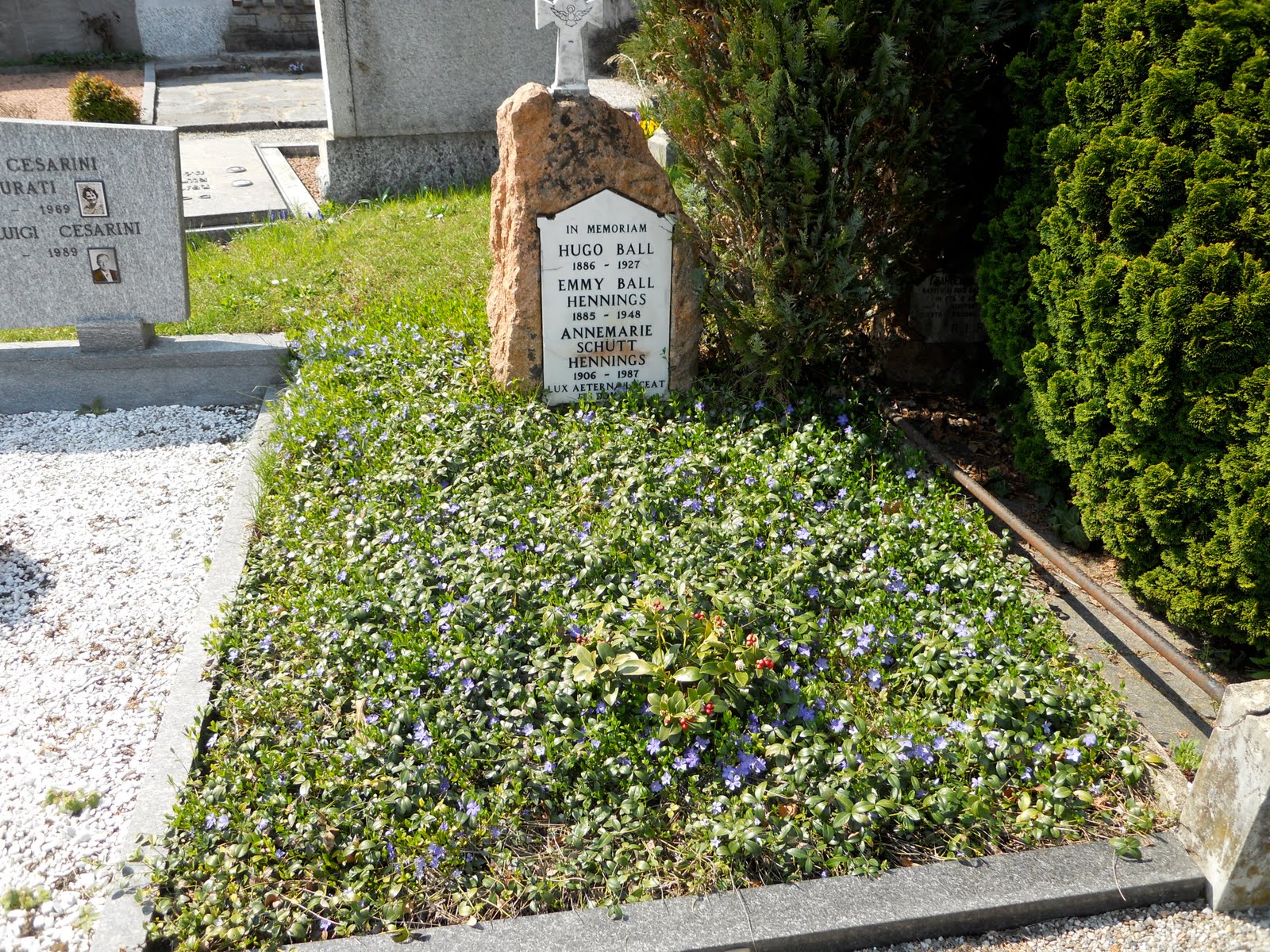
The Ball-Hemmings plot, Saint Abbondio Cemetery
Tristan Tzara happily took over the leadership of Zürich's Dada until the rowdy, eighth Soirée in Zunfthaus zur Kaufleuten in 1919, when the respectable audience, outraged by Dadaist provocations, stormed the stage. Then Dada left Zürich. Like avant-garde missionaries, Arp set up Dada in Cologne where Max Ernst, who would gain fame as a Surrealist, was converted; Huelsenbeck brought the movement to Berlin and Georges Grosz became a devotee; Tzara, together with Francis Picabia (freshly returned from New York), led a very active Dada brigade in Paris that, with the help of Max Ernst and André Breton, eventually metamorphosed into Surrealism and, from there, into the mainstream.
Zürich is not the sort of place that wears its history on its sleeve. The town that gave birth to Dada doesn’t exactly advertise the fact. The Zunfthaus zur Waag still serves hearty Swiss fare to bankers and tourists but bears no memorial to the events of July 14th 1914; Café Terrasse is an upmarket restaurant where few diners stop to reflect that Lenin once played chess here while Tzara ‘invented’ the term; Zunfthaus zur Kaufleuten has been recommended by The Financial Times as one of the hottest party places in Europe (I'm not sure how reliable a guide The Financial Times is for parties), but the final Soirée has been long forgotten; though Joyce immortalised Café Pfauen (Café Peacock) in his last novel Finningans Wake, as “Peacockstown”, he too has been all but forgotten by Zürich and Cafe Pfauen underwent a renovation last year and in the process lost its name. The inventor of modern dance, Rudolph Laban, has been all but erased from the city's history. As for Ball and Hennings, their many humble abodes in the Niederdorf still stand, but not one carries as much as a plaque. But not all has been forgotten – with the financial help of Nicolas Hayek of Swatch watch manufacturers, Cabaret Voltaire was reopened in 2004 as a café and exhibition space. It isn’t quite as wild as in the old days though.

Where it all started: inside Cabaret Voltaire today
If the world is fortunate enough to reach the year 2016, then we can be sure that those who fell in Verdun and at the Sommes will be remembered in official commemorations, and rightfully so. But so too the birth of Dada will be acknowledged, though perhaps on a smaller scale, with publications, exhibitions, the inevitable academic conferences. And as they both recede further into the past, who can say which will be forgotten, and which remembered - the war involving millions across the globe, or the art movement created by a handful on the banks of the Limmat?
For Further Reading
Hans Arp, Dada: Art and Anti-Art, tr. H. Richter, (London, 1956); Hugo Ball, Flight Out of Time: A Dada Diary, tr. A. Raimes, (Berkely, 1996); Brigitte Pichon and Karl Riha (eds), Dada Zurich: A Clown’s Game From Nothing, (New York, 1996); Erdmute Wenzel White, The Magic Bishop: Hugo Ball, Dada Poet, (Columbia, S.C., 1998).
Monday, May 17, 2010
Dada is Born: Part Two
This is part two of an essay on the birth of Dada. Part one appeared yesterday. I will post part three tomorrow.
The evening of March 31st in Cabaret Voltaire saw the first ever performance of “simultaneous poems” when three unrelated texts were chanted at the same time in three different languages, Huelsenbeck in German, Tzara in French and Janco in English. As if the audience had not been baffled enough, this was followed by Tzara and Huelsenbeck’s ‘Chants Nègres’, in which they recited African poetry, in their versions of the original languages, to the uncomprehending audience, accompanied by Huelsenbeck’s rhythmic drumming. The next couple of months saw a number of ‘Dances Nègres’, involving violent contortions of the limbs by dancers dressed in bright costumes of geometric forms and Janco’s astonishing cubist masks. African “primitiveness” had become a weapon to be used in a full frontal assault on the enemy – the imperial western tradition of beauty and reason.


The evening of March 31st in Cabaret Voltaire saw the first ever performance of “simultaneous poems” when three unrelated texts were chanted at the same time in three different languages, Huelsenbeck in German, Tzara in French and Janco in English. As if the audience had not been baffled enough, this was followed by Tzara and Huelsenbeck’s ‘Chants Nègres’, in which they recited African poetry, in their versions of the original languages, to the uncomprehending audience, accompanied by Huelsenbeck’s rhythmic drumming. The next couple of months saw a number of ‘Dances Nègres’, involving violent contortions of the limbs by dancers dressed in bright costumes of geometric forms and Janco’s astonishing cubist masks. African “primitiveness” had become a weapon to be used in a full frontal assault on the enemy – the imperial western tradition of beauty and reason.

Tristan Tzara
In April Tzara convinced the others that they should produce a regular journal. On April 18th Ball noted in his diary “My proposal to call it ‘Dada’ is accepted (…) Dada is ‘yes, yes’ in Rumanian, ‘rocking horse’ and ‘hobby horse’ in French. For Germans it is a sign of foolish naiveté, joy in procreation, and preoccupation with the baby carriage.” This is the first ever mention of the word “Dada”. Most agree with Ball that it was he, together with Huelsenbeck, discovered the word by plunging a knife into a German-French dictionary, though Tzara would later claim that it was he alone who had invented the word in Café de la Terrasse. Ball later added in his diary, “What we call dada is (…) the death warrant of posturing morality”.
In May most of Ball’s energy was taken up with editing the one and only edition of the journal Cabaret Voltaire. In June 500 copies were printed by an anarchist printer, Julius Heubeger. As well as contributions from Zürich’s Dadaists, it included work from a number of the leading lights of the European avant-garde - Picasso, Marinetti, Kandinsky, and Guillaume Apollinaire. The editor’s notes included the statement that the work should not be interpreted along national lines and that the editor emphatically rejected the “German Mentality”. There followed a list of contributors with their nationalities – Spanish, Russian, French, Rumanian, Italian. Last was Emmy Hennings’ name: her nationality was listed as “Homeless” (“Heimatlos”). This at a time when patriots of various nationalities were urging their compatriots to ever greater feats of human slaughtering.
In late June 1916 Ball recited the first of his famous ‘sound poems’. While Kandinsky had recently abolished images from his art, and consequently had invented abstract painting, Ball now abolished language from his poetry. It was an attempt to reach to the depth of primitive being and utter mantra like, pre-articulate, magical sounds. Clad in a cylindrical costume that he had made himself out of shiny, blue cardboard, he appeared like an obelisk with wings and claws and a shaman’s hat. The costume was so heavy he had to be carried onto the stage. He began the poem that opens with the lines:
gadji beri bimba
glandridi laula lonni cadori

Dada's Magic Bishop - Hugo Ball
Gradually his chanting took on “the ancient cadences of the priesterly lamentations” in the style of “the mass hymns that fill the Catholic churches of the Orient and Occident with sorrow”. That evening he recorded in his diary how, for a moment “it seemed as if there were a pale, bewildered face in my cubist mask, that half-frightened, half-curious face of a ten year old boy, trembling and hanging avidly on the priest’s words in the requiems and high masses in his home parish. Then the electric lights went out, as I had ordered, and bathed in sweat, I was lowered off the stage like a magic bishop.”

Hugo Ball in Cabaret Voltaire
But magic or not, Cabaret Voltaire was not selling enough beer and sausage to satisfy the philistine restaurant owner, and the Dadaists found themselves evicted out of their Niederdorf home. On July 14th 1916, round about the time that British cavalry were attacking German forces at the Somme in one of the war’s most pointless exercises, the artists arrived in the stately Zunfthaus zur Waag, on the more respectable west bank of the River Limmat. It was the first of what would eventually become eight public “Dada Soirées”. The event was well publicized beforehand and reviewed in a number of newspapers during the next few days, including the respectable Neue Zurcher Zeitung. The evening was the usual combination of Hennings’ poetry, Huelsenbeck’s Chants Négres, acoustic experiments on the piano from Swiss musician Hans Heussers, expressive dancers from Rudolph Laban's newly opened school, Arp’s abstract collages, Ball’s sound poems, Taueber's puppets, Tzara’s simultaneous poetry – this time with four voices, and, to close, a grotesque comical dance with Janco’s cubist masks. Each of the core members read out a manifesto. Ball’s Dada manifesto included:
“Words emerge, shoulders of words, legs, arms, hands of words. Au, oi, uh. One shouldn’t let too many words out. A line of poetry is a chance to get rid of the filth that clings to this accursed language as if put there by stockbroker’s hands, hands worn smooth by coins. I want the word where it ends and begins. Dada is the heart of words. Each thing has its word, but the word has become a thing in itself. (…) The word, gentlemen, is a public concern of the first importance”.
Holding court in his favourite café in Zurich, Café Pfauen, an Irish writer by the name of James Joyce, who was working on a book called Ulysses, might have agreed with such deliberations.
Sunday, May 16, 2010
Dada is Born: Part One
Here is part one of an essay on the birth of Dada. I'll upload part two tomorrow.
 Zunfhaus zur Waag (photo: Marco Zanoli)
The grand guildhouse Zunfthaus zur Waag doesn’t look like a likely site for staging a revolution. It stands on the Münsterhof, a prestigious medieval square just a stone’s throw from the financial heart of Zürich. On July 14th 1916 a collection of young poets, writers and artists came together here to enjoy an evening of music, poetry, painting, and dance with fantastic masks and costumes. While in other corners of Europe the dying world of the 19th century was being dismembered in the bloodiest battles ever seen, in this quiet Swiss backwater the crazy, playful world of Dadaism had burst forth, and, for better or for worse, the anti-art of conceptual art was born.
 Cabaret Voltaire, 1916
According to Ball, what they were doing was “reminding the world, across the war and other fatherlands, of those few independent spirits that live for other ideals.” What those ideals were exactly was hard to capture in words. Tzara wrote: “I am against systems, the most acceptable system is on principle to have none. To complete oneself, to perfect oneself in one’s littleness, to fill the vessel with one’s individuality, to have the courage to fight for and against thought, the mystery of bread”. Certainly the Dadaists valued spontaneity over reason, anarchy over order, freedom over harmony.
Ball and Hennings were convinced pacifists by this time. All of the Dadaist shared a repulsion of the war. As Arp expressed it: “Revolted by the butchery of the 1914 World War, we in Zürich devoted ourselves to the arts. While the guns rumbled in the distance, we sang, painted, made collages and wrote poems with all our might.” In late February the German army commenced its attack on the French at Verdun, a battle that would kill 700,000. A few nights later Hugo Ball sat at the piano in Cabaret Voltaire, surrounded by friends from most of the warring nations and played Debussy’s “Berceuse Heroique”. The French composer had written this work to honour the people of Belgium for their heroic resistance to the Germans in 1914. Now Ball, a German national, could not have defined himself more clearly as an opponent of German nationalism.

The grand guildhouse Zunfthaus zur Waag doesn’t look like a likely site for staging a revolution. It stands on the Münsterhof, a prestigious medieval square just a stone’s throw from the financial heart of Zürich. On July 14th 1916 a collection of young poets, writers and artists came together here to enjoy an evening of music, poetry, painting, and dance with fantastic masks and costumes. While in other corners of Europe the dying world of the 19th century was being dismembered in the bloodiest battles ever seen, in this quiet Swiss backwater the crazy, playful world of Dadaism had burst forth, and, for better or for worse, the anti-art of conceptual art was born.
Dada was to a large degree the child of the German poet Hugo Ball, and his partner Emmy Hennings. Born in Germany in 1886 Ball had become absorbed by the ideas of Nietzsche while at university. Leaving before finishing his dissertation, he threw himself into the world of avant-garde theater in Munich and Berlin. In 1913 he met Hennings at the famous Café Simplicissimus. She was a singer and dancer and, a year older than Ball, more experienced in many ways. She had a child from a previous marriage and a string of ex-lovers in the German art world; she had traveled in Eastern Europe and had done a term in prison. She used drugs and introduced Ball to the delights of narcotics.


When war broke out in 1914 Ball had volunteered for the army but was turned down on medical grounds. He then traveled to Belgium and witnessed the carnage inflicted upon men by mechanized warfare. What he saw appalled him and he and Hennings began to actively oppose the war. In 1915 they arrived in Zurich on false passports.
Zürich during the war had become a haven for international revolutionaries, pacifists, artists, writers and contraband criminals. The city's foreign population included James Joyce, Stefan Zweig and Vladimir Ilyich Lenin. Like most migrants, Ball and Hennings lived and worked in the warren of alleys that make up the Niederdorf quarter of the city. This was an area where no self respecting Swiss burgher would want to be seen, notorious as a cesspool of alcoholism, drug addiction, indecency, crime and venereal diseases. Seven out of every ten buildings housed a bar or club where dancing girls, unusual animals, dwarfs, fat ladies and other “freaks” were on offer. The couple moved every few months, constantly pursued by a gnawing poverty. At one point Ball was imprisoned for twelve days for having a false passport. By August 1915 the couple had become destitute, sleeping rough and forced to scavenge for food. Then Ball found employment as a pianist with a vaudeville troupe in Basel while Hennings worked in the Niederdorf quarter as a singer and dancer in a variety show. According to Zürich police records, she subsidized her morphine habit with prostitution.
In early 1916 Ball returned to Zürich and in February he rented a small room adjacent to a restaurant in a dark alleyway, Spiegelgasse 1. (Russian Bolshevik revolutionary Vladimir Ilyich Lenin moved into a room a few yards further up at Spiegelgasse 14 in mid-February). On February 5th they opened this space as a new club for young artists and performers. They called it Cabaret Voltaire. From February until July this dark premises hosted loud, smoke-filled evenings of noise music, simultaneous poems, mystical incantations, Russian balalaika bands, songs in Danish, verses in Rumanian and bizarre dances in grotesque masks and outlandish costumes. The works of friends – Arp, Picasso, Modigliani, Marinetti, and Macke, decorated the walls. Ball and Hennings were joined, as ‘core’ members of the group by 20 year old Tristan Tzara, a confident and witty Rumanian poet, 21 year old Marcel Janco, a quiet, friendly Rumanian who made paintings, posters and cubist masks, Richard Huelsenbeck, a 24 old argumentative German doctor and poet with an interest in the rhythms of music and language, 29 year old Hans Arp, from Strasbourg, a talented visual artist of some reputation and 27 year old Sophie Taeuber, an innovative local artist, set designer and dancer. Arp has left us a description of what it was like:
“Total pandemonium. The people around us were shouting, laughing and gesticulating…. Tzara is wriggling his behind like the belly of an Oriental dancer. Janco is playing an invisible violin and bowing and scraping. Madame Hennings, with a Madonna face, is doing splits. Heulsenbeck is banging away nonstop on the great drum, with Ball accompanying him on the piano, pale as a chalky ghost”.

According to Ball, what they were doing was “reminding the world, across the war and other fatherlands, of those few independent spirits that live for other ideals.” What those ideals were exactly was hard to capture in words. Tzara wrote: “I am against systems, the most acceptable system is on principle to have none. To complete oneself, to perfect oneself in one’s littleness, to fill the vessel with one’s individuality, to have the courage to fight for and against thought, the mystery of bread”. Certainly the Dadaists valued spontaneity over reason, anarchy over order, freedom over harmony.
Ball and Hennings were convinced pacifists by this time. All of the Dadaist shared a repulsion of the war. As Arp expressed it: “Revolted by the butchery of the 1914 World War, we in Zürich devoted ourselves to the arts. While the guns rumbled in the distance, we sang, painted, made collages and wrote poems with all our might.” In late February the German army commenced its attack on the French at Verdun, a battle that would kill 700,000. A few nights later Hugo Ball sat at the piano in Cabaret Voltaire, surrounded by friends from most of the warring nations and played Debussy’s “Berceuse Heroique”. The French composer had written this work to honour the people of Belgium for their heroic resistance to the Germans in 1914. Now Ball, a German national, could not have defined himself more clearly as an opponent of German nationalism.
To be continued....
Tuesday, May 11, 2010
Radu Lupu in the Tonhalle, Zurich

Writing on music tends to be either overly technical or a list of similes. Very few can manage to do it well. Alas, I am inept. And this is a pity, because on Sunday night I experienced a musical evening that was unforgettable – indeed the music resonated so deeply that hours after the concert it still wouldn’t leave my mind and kept me awake. Unfortunately I can’t describe architecture very well by dancing and I cannot share the music by writing about it.
The recital was by the great Romanian pianist, Radu Lupu, performing Janacek, Beethoven and Schubert in Zurich’s Tonhalle. During Lupu’s interpretation of Beethoven’s “Appassionata” Sonata I felt he was close to unfolding a sound picture that would manifest a truth, but one which does not lend itself to translation into words. Perhaps for this reason Lupu plays the piano, and seldom if ever gives interviews. He sat before the magnificent grand piano looking utterly relaxed, his fingers barely touching the keys, like an ancient Hindu sage sending out messages of wisdom encrypted in music. Schubert’s Piano Sonata in B Flat is one of my favourite pieces of music. Radu Lupu seemed to play it, not with his fingers, but with his being. There was an extraordinary lack of intensity in his approach; instead, with little outward demonstration of effort, he offered the lightness of the Zen master. He was in such command of his instrument that, ironically, the effect was that Radu Lupu himself was erased and the music alone was revealed.
At the end of the concert he bowed, and left the stage, returned, bowed, and left again. As the applause grew louder he returned to the stage, bowed, sat before the piano and immediately began to play again – the first of two encores. The second encore was one of Schubert’s Impromptus, but though I recognized the first, or at least seemed to, I couldn’t quite place it, and have failed to identify it since. To call it incredibly beautiful would be an understatement. It was perfect.
If any reader happened to be at the concert and knows which piece it was, I would love to know.
Saturday, May 8, 2010
David Zinman and the Tonhalle Orchestra in Zurich

A couple of months ago my wife and I attended a concert at the Tonhalle of Wagner's Act One of Die Walkure. Zinman and his orchestra were in tremendous form and even Esther, most definitely NOT a Wagner fan (in an act of great selflessness, she had bought the tickets as a gift for me), was bowled over. But I was worried as Zinman is 74 years old and his contract ends this year. I was pleased to read that he has just signed a new contract, which will keep him at the helm until the tender age of 79. Surely that is a clear demonstration of a man who loves his work. It makes me wonder, will I still want my day job if I live to 79?
Wednesday, May 5, 2010
On no! Heidi's Daddy was a German
Well, it seems like disaster has well and truly hit Switzerland this time. Heidi may have had a German father! This will certainly provide more fodder for the anti-German antics of the leading Swiss xenophobic political party, the Swiss People's Party (SVP). Riding high after their successful campaign to ban minarets, the SVP turned their sights on the growing German population in Switzerland, focusing especially on Zurich's universities. They have tried to initiate a campaign that would lead to placing a ceiling on the number of Germans who may be employed as lecturers and professors (despite the fact that there aren't many unemployed Swiss professors). And now, irony would have it, it is a German scholar at the University of Zurich who has discovered a story published in German by a German author fifty years before Johanna Spryi's novel Heidi appeared, which bears a remarkable resemblence to the world famous Swiss novel. But no, surely the Germans can't rob the Swiss even of this; after all, as one commentator said: "Heidi is Switzerland and Switzerland is Heidi." It has been a year of disasters for poor Switzerland - a diplomatic war with Libya in which Ghaddafi kidnapped Swiss citizens and continues to humiliate the Swiss government; the great UBS bank, biggest of the big, loses billions while its criminal behavior in the US gets compared to that of the mafia; the banning of minarets calls up a storm of protest from around the world. Poor misunderstood Switzerland. But at least we had Heidi. Now they are stealing her from us.
 Birthplace of Johanna Spyri in Hirzel (Photo: Adrian Michael)

Subscribe to:
Posts (Atom)