
Sunday, April 18, 2010
Museum of the Reformation in Geneva


Wednesday, April 14, 2010
On Finding a Book

It was July 1980. I had been travelling for three years. In the multitudinous din that was India I was alone. Emaciated, jaded and worryingly low on funds, I arrived in the holy city of Madurai. Near the grand temple I found a room in a cheap hotel, a loveless place called Venus: a small window, a bowl and jug of water on the floor and a narrow bed. Hidden under the bed I found, like a discarded miracle, a copy of Hermann Hesse’s Siddhartha. Sitting cross legged on the bed I opened the book and my eyes read the most beautiful sentence ever written: “In the shade of the house, in the sunshine on the river bank by the boats, in the shade of the sallow wood and the fig tree, Siddhartha, the handsome Brahmin’s son, grew up with his friend Govinda.” Reading that sentence, so unexpected, was the purest aesthetic experience I had ever had. I recognized that then, and I can recall it still – aesthetic joy. The sounds of the surging Indian city outside were stilled as I read on in a pool of silence and finished the novel. Then I started again. When I left the hotel, three days later, I left the book where I had found it. Perhaps someone else right now is savouring their first encounter.
Some months later I was living in an attic room in a tall red-bricked building in a Dutch university town, lashed by the salty rain that rolled in off the cold North Sea. I had by then bought my own copy of Siddhartha and I read Hesse’s other works as if the ancient oracle of Delphi was whispering obscure wisdoms into my restless mind, Narcissus and Goldmund, Steppenwolf, The Glass Bead Game.
Of course everyone of my generation read Hesse during their youth. We grow up, and we put childish things to one side. I have grown to become less adventurous and much less filled with the aching of idealistic hope. Aesthetic enjoyment is less likely to pounce unexpectedly, more likely to be revealed in the shade of the house rather than in the sunshine on the river bank. Wagner has replaced Hesse. Still, when I moved to Zurich and discovered that Siddhartha had first appeared in installments in the local newspaper, the Neue Zurcher Zeitung in 1922, strange as it might seem, it helped me to feel at home in the city. Hesse loved this city too, I discovered. During his writing of Steppenwolf he spent a part of every year here. And so, now middle aged, I find myself hunting for his opinions of the city and searching out his old haunts, about which I will write on another occasion.
And the moral of this story? Never regret leaving a book behind.
Sunday, April 11, 2010
Review of Hitler by Ian Kershaw

Wednesday, April 7, 2010
James Joyce and Zurich’s Fair City

Ask any Irishman and he’ll tell you, Ulysses, by James Joyce, is the greatest novel ever written. Even those of us who have never read the book know that! Dubliners are particularly proud of this portrait of their city immortalised in literature. Funnily enough, when you reach the last page of the greatest yarn ever spun, you discover the final words: “Triest-Zurich-Paris 1914-1921”. Not a single word was actually written in the dirty old town by the Liffey; the bulk of the book was penned in Zurich’s fair city. The visitor to Zurich today could easily search in vain for any sign of Joyce. And yet, when you know where to look, you can easily walk, or even stagger, in his meandering footsteps. And, if you know Joyce at all, you’ll have already guessed that the place to look for him is in the cafes and pubs of Zurich.
Leaving the main exit of the Central Railway station, where Joyce first arrived in the city, we find ourselves on the sophisticated Bahnhofstrasse, Europe’s most expensive shopping street. In 1918 Joyce wrote a melancholic poem named after this street, in which he wonders where his youthful dreams have disappeared to;
Highhearted youth comes not again
Nor old heart’s wisdom yet to know
The signs that mock me as I go.

Central Railway Station and Bahnhofstrasse
When Joyce originally left Ireland it was Zurich he headed for, back in 1904. He had just married Nora Barnacle, but on the days and nights of ferries and long train journeys that brought them from Dublin to Zurich the couple had not yet had a chance to consummate their marriage, as they say. Upon arriving at the railway station they headed for the nearest cheap accommodation that they could find, and there the deed was done, in a guesthouse called “Hopeful”. Alas, nothing remains now of that historic establishment, and no memorial commemorates the spot. Instead we have the practical but ugly Post Office building to the right of the main railway station.
Joyce’s first stay in Zurich was brief, but a little over a decade later the couple were back, together with their two children, Giorgio and Lucia. It was 1915 and Europe was at war. Zurich had become a haven for an army of international revolutionaries, reformers, philosophers, artists, and pacifists – all escaping the continent wide butchery.
So many refugees from the war found a home in Zurich that the Bahnhofstrasse became known as Balkanstrasse. A five-minute stroll along this street and we turn left into the Augustinergasse and right there we come to one of Joyce’s many watering holes in the city, the Restaurant Augustiner. It has become a wee bit more expensive then in Joyce’s time, when he would be a regular for lunch, sitting elbow to elbow with Swiss workers and Czech immigrants.

Augustinersgasse with Restaurant Augustiner on the far left
Further up the street we find the Augustiner Church and the community of Old Catholics who worshipped here were a fascination of Joyce’s. The presence of Greek immigrants and refugees in this quarter inspired Joyce as he worked on his ‘Greek’ novel, Ulysses. On the left we have the James Joyce Corner, one of a few remembrances to him in the city, and to the right we find the James Joyce Foundation. They have a small library here, conferences and readings are organised and the friendly staff are always welcoming to visitors.

The Joyce Foundation
Proceeding down through the Old Town we reach the River Limmat and on the opposite bank, beyond the twin towers of the Grossmunster cathedral, we find a great old restaurant with a huge oval window. This is Café Terrace, again, one of Joyce’s regular places to meet friends and drink Swiss white wine. A lovely place to eat a pricey meal in the summer, you can drop in for a refreshment too.

Cafe Terrace
Across the road, just down from Starbucks (yes, I’m afraid it has reached even here …) we find one of Europe’s grandest cafés, Café Odeon. It was here that Einstein explained his ideas on relativity to his students from the nearby Federal Institute of Technology, and years later Herman Hesse would be a nightly visitor as he worked on his novel, Steppenwolf. In Joyce’s time Lenin, the father of the Russian revolution, came here to quench his thirst and dispute with other Russian revolutionaries, while the wild artists and poets of the Dada art movement argued and raged against bourgeois cultural values. There’s a good chance that Lenin and Joyce both sat and drank here at the same time, but we have no evidence that they ever actually laid eyes on each other. Which hasn’t prevented Tom Stoppard from writing a play in which they do.

Cafe Odeon
On the corner opposite the Odeon we have restaurant Kronenhalle. Joyce didn’t come here often during World War I – it was beyond his budget. But in the 1930s while living in Paris, he returned to Zurich frequently and after becoming friendly with the owners this quickly became his favourite restaurant. The Kronenhalle became somewhat of a Mecca for artists and today its walls are decorated with works by the likes of Miro and Picasso, but they still have the famous Joyce Table too, surrounded by photos of the writer. The Kronenhalle has one more claim to fame - it was here that Joyce ate his very last meal in January 1941. After dinner he became ill, was hospitalised, and died two days later. Not a great ad for the restaurant, though I have been assured that the food is excellent, and perfectly safe.
If we now walk up the Ramistrasse, up a somewhat steep hill between the Kronenhalle and the Odeon, we come to Joyce’s favourite watering hole. How many favourites did he have, I hear you ask. But no, seriously, this was his very favourite – the Pfauen or Peacock. Joyce, having the kind of mind that he had, took some satisfaction that “Peacock” sounded just like “Pee/cock”. Maybe that’s why he named Zurich in his last novel Finnegans Wake, “Peacockstown”. Another reference to Café Pfauen in that difficult work is, “Evropeahahn cheic house”. It was here that Joyce held court, reading from the manuscript of Ulysses, breaking into song while swilling down bottles of Fendant de Sion and later, still singing, walking home through the snow filled sober streets of Zurich. Alas, the cafe is much changed since Joyce's days, and is now known as cafe terroir.

Formerly Cafe Pfauen
And we can follow him back down the hill and swing left at the Kronenhalle, past the Opera House to our right and onto the Seefeldstrasse. Joyce lived in no less than four houses in this area, but not at the same time of course. The houses are all still standing though not one of them carries as much as a plaque. They are all just a five-minute walk from each other. The Joyce family first lived in two cramped rooms at the Reinhardstrasse 7. The house today looks much like it must have done then, just about ready to collapse. Goodness knows how long more it will stay standing. An artist rents one of the rooms and you can hear a babble of different languages if you stop at the door, which is usually open, as I do. Then the family moved to the third floor of a prominent yellow building on the Kreuzstrasse 19. Today the ground floor is a sex video store called “Sexy Market”. I can hear Joyce chuckling at that one. Six months later they moved to the Seefeldstrasse 54, above a garage then, today it is still above an Alfa Romeo garage. But Joyce complained of the dampness and in January 1917 they moved into two spacious rooms facing the street on the third floor of Seefeldstrasse 73. It is still a lovely building today, with an antique store on the bottom floor.
Now after that bit of house hunting it’s probably time to sink a pint in true Irish style. Let’s head back along the Bahnhofstrasse and turn into the Pelikanstrasse where we can nip into the James Joyce Pub. It may not look like the real thing from outside, but push open the door and you enter an authentic 19th century Irish pub. The James Joyce Pub is nothing less then the original Juries Pub that Joyce frequented in Dublin and that even gets a mention in Ulysses. The entire furbishing was bought by a wealthy Swiss businessman, and Joyce fan, and shipped here, lock stock and Guinness barrel. Slainte!
Replenished we head back to the train station and out the other side, into the park that lies behind the neo-Gothic National Museum. Here, at the confluence of the rivers Limmat and Sihl, we stand on what was Joyce’s favourite spot in Zurich. It earns a mention in Finnigan’s Wake when he refers to the River Limmat: "Yssel that the Limmat?"and a number of photos of Joyce standing at this point, with his back to the Limmat, were taken here.


Back at the National Museum we can take tram 6 for three stops to the Universitatstrasse 29. Right at the bus stop we find yet another house where Joyce lived and worked on Ulysses. This is the only one that bears a plaque. It says, in German: “Here lived the Irish writer James Joyce in 1916 while he worked on his novel Ulysses”.
We have one more stop to make. Tram number 6 brings us to the end of the line. Literally. Simply follow the crowds. They are going to the zoo. But we turn at the first gate into a graveyard. A stone map will indicate the route to the Dubliner’s last resting place. He had returned to Zurich in December 1940, fleeing a war even more bloody than the first. The family was near penniless, the daughter, Lucia, was insane; Joyce himself was blind, haunted by feelings of guilt and depression, and crippled by a new ailment, a pain in his gut. He died on a cold January morning two weeks later. Nora Barnacle stayed on in Zurich, sinking into an ever-deeper loneliness, and died here in 1951. Today the couple share a grave in a peaceful corner of the wooded cemetery, backing onto the zoo. The only statue of Joyce in this city marks the plot. A Japanese maple turns fiery red in spring and autumn. The Nobel Literature Laureate, Elias Canetti is a neighbour. At night, as in all cemeteries, silence reigns, broken only by the occasional sound of animals encaged.

Joyce's Grave
Sunday, April 4, 2010
The Second Battle of Zürich
On the edge of my village, just a few hundred metres from my house, I stumbled across this commemorative pseudo-Roman pillar a few years ago.

I must have passed it many a time before noticing it. It bears an inscription explaining that this was the scene of a battle during the French-Russian war of 1798-‘99. When you look close, you can see what appears to be a hat from the French Revolutionary army.

Wow! My first thought was, were the Russians here? In my little leafy Swiss village! Actually the inscription states that the French army was encamped here protecting the Albis Pass during the Second Battle of Zürich.

A few weeks after discovering the monument I was teaching the French Revolution and I came across the following in our textbook by Dylan Rees and Duncan Townson: “French forces withdrew from the whole of Italy, except Genoa, as the Russians moved into Switzerland. It appeared that France would be invaded for the first time in six years, but, as had happened before, France was saved by quarrels among the allies. Austria, instead of supporting Russia in Switzerland, sent her best troops north to the Rhine. This allowed the French to move on to the offensive in Switzerland, where the Russians withdrew in the autumn of 1799." The penny dropped and I guessed that the famous Russian retreat led by General Suvarov, one of the most successful in military history, had passed right before my house (well, not literally, since my house is only ten years old). Alas, my guess proved to be not quite accurate, and the truth is a little less spectacular than I had first thought, though only a little.
The 70 year old Suvarov had won one battle after another, chasing the French Revolutionary army out of Central Europe. But political intrigues among the anti-French coalition – the British, Austrians and Russians, meant that the British and Austrians had left the Russians in Northern Italy and Switzerland in the lurch. Zurich had been in the hands of the Russians since June 1799, however a French force remained just across the river Limmat. The French counter attacked in September, placing a force on the outskirts of my village. The Russians need to withdraw over these hills, which I can see from my upstairs window. (The following two photos are taken from my house)
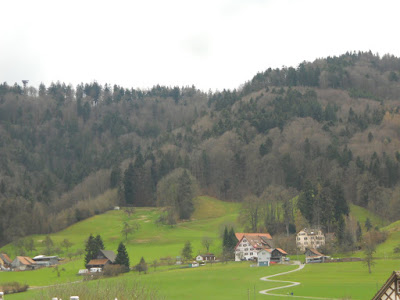
There is one road that winds over the ridge called the Albis Pass. The French were encamped in my village at the foot of the pass. You can see the road snaking up the hill in this photo.

The French, led by the General Massena (he would go on to enjoy a brilliant career under Napoleon) surprised the Russians, and won the day. Suvarov, was hastening from the south towards Zurich, but when he heard of the defeat, he turned and began his retreat over the Alps. It was already snowing by then, but thanks to incredible endurance he brought his army over the mountains, at what is now the ski resort Elm, to safety in Austrian occupied Chur. If you look very, very closely at this photo of the monument you can see the Alps in the distance (you might need a magnifying glass, but believe me, they are there).

So, the legendary General Suvarov never did quite set foot in front of my house afterall, but still, a little bit of history was played out in my village nestled below the Albis Pass. The Second Battle of Zurich, fought in September 1799, was fierce with over 8,000 Russian casualties. Some years ago the remains of nine Russian soldiers were uncovered in a building site in the city. They had lain under a house for two hundred years. Who knows what lies under the ground upon which we walk?

I must have passed it many a time before noticing it. It bears an inscription explaining that this was the scene of a battle during the French-Russian war of 1798-‘99. When you look close, you can see what appears to be a hat from the French Revolutionary army.

Wow! My first thought was, were the Russians here? In my little leafy Swiss village! Actually the inscription states that the French army was encamped here protecting the Albis Pass during the Second Battle of Zürich.

A few weeks after discovering the monument I was teaching the French Revolution and I came across the following in our textbook by Dylan Rees and Duncan Townson: “French forces withdrew from the whole of Italy, except Genoa, as the Russians moved into Switzerland. It appeared that France would be invaded for the first time in six years, but, as had happened before, France was saved by quarrels among the allies. Austria, instead of supporting Russia in Switzerland, sent her best troops north to the Rhine. This allowed the French to move on to the offensive in Switzerland, where the Russians withdrew in the autumn of 1799." The penny dropped and I guessed that the famous Russian retreat led by General Suvarov, one of the most successful in military history, had passed right before my house (well, not literally, since my house is only ten years old). Alas, my guess proved to be not quite accurate, and the truth is a little less spectacular than I had first thought, though only a little.
The 70 year old Suvarov had won one battle after another, chasing the French Revolutionary army out of Central Europe. But political intrigues among the anti-French coalition – the British, Austrians and Russians, meant that the British and Austrians had left the Russians in Northern Italy and Switzerland in the lurch. Zurich had been in the hands of the Russians since June 1799, however a French force remained just across the river Limmat. The French counter attacked in September, placing a force on the outskirts of my village. The Russians need to withdraw over these hills, which I can see from my upstairs window. (The following two photos are taken from my house)

There is one road that winds over the ridge called the Albis Pass. The French were encamped in my village at the foot of the pass. You can see the road snaking up the hill in this photo.

The French, led by the General Massena (he would go on to enjoy a brilliant career under Napoleon) surprised the Russians, and won the day. Suvarov, was hastening from the south towards Zurich, but when he heard of the defeat, he turned and began his retreat over the Alps. It was already snowing by then, but thanks to incredible endurance he brought his army over the mountains, at what is now the ski resort Elm, to safety in Austrian occupied Chur. If you look very, very closely at this photo of the monument you can see the Alps in the distance (you might need a magnifying glass, but believe me, they are there).

So, the legendary General Suvarov never did quite set foot in front of my house afterall, but still, a little bit of history was played out in my village nestled below the Albis Pass. The Second Battle of Zurich, fought in September 1799, was fierce with over 8,000 Russian casualties. Some years ago the remains of nine Russian soldiers were uncovered in a building site in the city. They had lain under a house for two hundred years. Who knows what lies under the ground upon which we walk?
Friday, April 2, 2010
Bruckner's Mass in F Minor

Tonhalle, Zürich (photo: Andreas Praefcke)
Yesterday it was 25 years since my wife and I had our first date – April Fool’s Day.
Twenty five years ago we went to Bach’s Matthäus Passion, in Groningen, Holland. Last night we celebrated by attending Bruckner’s Mass in F Minor at the Tonhalle in Zürich, together with our three children. It dawned on us afterwards that for over half of our 25 years we have been parents, our eldest having just turned 13.
Whenever I enter the Tonhalle I feel like I am threading on hallowed ground, and I can’t help but feel the presence of history. Since its opening in 1895 it has gained a reputation for having one of the finest acoustics in the world. No less a figure than Brahms himself conducted on the very first opening night. Since then such greats as Karl Böhm, Wilhelm Fürtwangler, Otto Klemperer, Bernard Haitink and Wolfgang Sawallisch have followed his example. The in house conductor and musical director today is David Zinman and recent musicians who played under his baton include Yo-Yo Ma, Krystian Zimerman and Alfred Brendal. Esther and I already have our tickets to see Radu Lupu in June.

After the performance
Last night's was a stellar performance by the Kollegium Wintertur (founded in 1629, making them one of Europe’s oldest musical ensembles) and the Mixed Choir of Zürich, founded in 1863. The evening included two of Bruckner’s motets – challenging pieces for any choir because of their exceeding complex polyphony and rich harmonic language– which are performed acapella, increasing the difficulty for the choir as they have to change key and modulation abruptly, without the support of any instruments. But the choir, led by their conductor Joachim Krause, did an outstanding job. My eight year old did fall asleep on my lap, but the 11 and 13 year olds, fans of Rhianna rather than classical music, were engrossed throughout the one and a half hour performance.
It was wonderful to celebrate our anniversary in this way, though there was one big difference. I sat among the audience with our three children; Esther was on stage singing. Although photos are not allowed during the performance, I did sneak this one quick, not very clear, one. Esther is in the back row, second from the left.

Thursday, April 1, 2010
The Evil of Smithfield Foods
 |
| website of "environmental leader" Smithfield |
In the politics of food, the individuals who run Smithfield are like gigantic bullies, destroying livelihoods and multiplying misery. Thanks to their wagonload of lawyers and bought politicians they destroy ecosystems almost with impunity. For the moment, let’s forget about the farmers whose livelihoods Smithfield destroy, the suffering animals Smithfield torture on a massive scale and the poor workers whose labour Smithfield exploits in the vilest manner. Instead let’s just focus on what Smithfield is doing to our environment and health, after all, on their own website they describe themselves as being “stewards of the environment” and committed to “environmental leadership”.

Of course sometimes Smithfield goes too far and even the politicians who live in Smithfield’s pocket can’t protect them. Like in 1997 when Smithfield was found guilty of a few thousand violations of the Clean Water Act. The company had knowingly dumped pollutants, including deadly faecal coli forms. Safran Foer doesn’t tell us this, but according to The Guardian (May 2nd, 2009)most troublingly, they were also found guilty of falsifying documents (i.e. lying) and destroying records. To pay for their sins they were fined a grand total of 12.6 million dollars, the amount of money it takes them ten hours to earn, every ten hours.
Of course we in Europe, with our much tighter pollution laws, can count ourselves lucky, right? Since 1999 Smithfield has opened operations in Europe and moved into Poland, Romania, Spain, France, the UK (Norwich Food), as well as Mexico, Brazil and China. The upheaval they have caused in Eastern Europe has been particularly disturbing, described by The New York Times (May 5th, 2009) as one of “the Continent’s biggest agricultural transformations”. Backed by its vast resources, including EU subsidies, and powerful local political allies, Smithfield is spearheading an agricultural revolution that ignores the protests of local small farmers and residents. Big money talks and in 2001 Smithfield was able to thumb its nose at EU environmental regulations when Poland and Rumania reclassified pig manure as a “product” rather than a waste. Now Smithfield’s dumping of “slurry” threatens the ecosystem of Northern Poland and the Baltic Sea. You can watch a video on Youtube that shows one of its spillages in Poland, which includes not just tons of fecal waste, but also still born piglets, afterbirth, dead piglets and syringes. So much for EU regulations. Robert Kennedy Jr. spoke to the Polish Senate on how “Smithfield’s invasion of North Carolina” has killed over 100 million fish in that state’s rivers. But his speech fell on deaf ears.

Meanwhile, the recent swine flu epidemic broke out just five miles from Smithfield’s new hog farm in Mexico, the world’s biggest. A large number of cases were recorded closer to Smithfield’s original home, in North Carolina. And swine fever swept through three of Smithfield’s Romanian hog compounds, two of which, surprise, surprise, they had opened without having a permit.
If only this were an April Fool's joke - but the joke is on us and Smithfield must be laughing. Jonathan Safran Foer summed it up: “one couldn’t imagine a more seemingly depraved company than Smithfield”.
Subscribe to:
Posts (Atom)